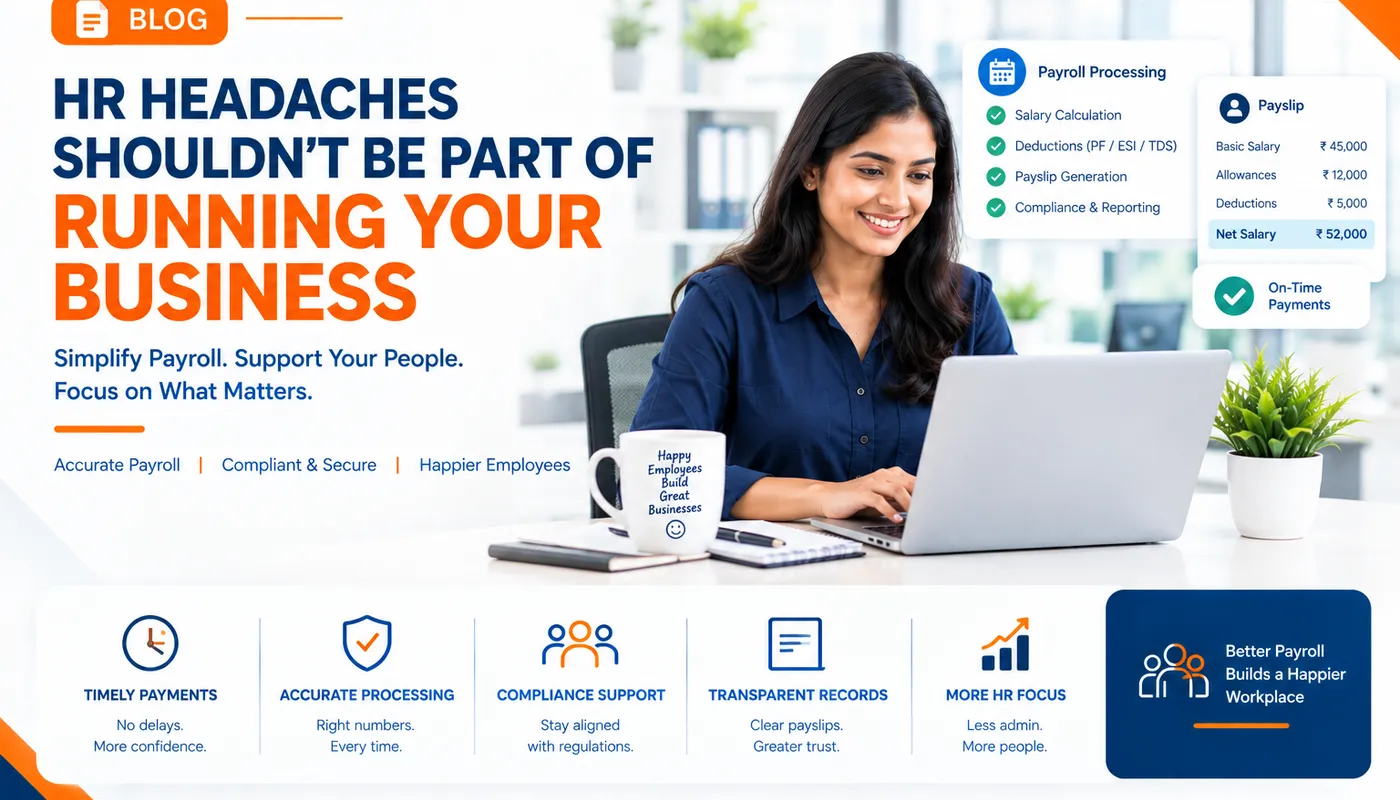
What Is Payroll Management and Why Does It Matter?
Payroll is one of the most important recurring processes in any organisation. Every month, employees expect their salaries to be calculated correctly, processed on time and supported by accurate documentation.
But payroll management involves much more than transferring salaries to employee bank accounts.
Payroll management India refers to the structured process of managing employee salary calculations, payroll inputs, deductions, employee records, salary slips, reporting and applicable statutory requirements.
For businesses, getting payroll right matters because payroll directly affects employees, HR operations, finance processes and compliance. A well-managed payroll process can reduce errors, improve administrative efficiency and create greater confidence among employees.
As companies grow, payroll can become increasingly complex. More employees, changing salary structures, attendance inputs, leave records and statutory requirements can make manual payroll administration difficult to manage.
This is why businesses need a clear, consistent and reliable payroll process.
Payroll Management at a Glance
Payroll management is the complete process of collecting employee information and payroll inputs, calculating salaries and applicable deductions, processing payments, maintaining payroll records and managing relevant compliance activities.
A typical payroll process may include:
- Employee data management
- Attendance and leave inputs
- Salary calculation
- Salary deductions
- Tax deductions
- Payroll processing
- Salary slip generation
- Payroll reporting
- Payroll reconciliation
- Statutory compliance
- Payroll documentation
The exact process varies according to the organisation, workforce and applicable requirements.
What Does Payroll Management Include?
A professional payroll process covers several activities that need to work together.
1. Employee Data Management
Accurate employee information is the foundation of payroll.
Payroll teams may need to manage information such as:
- Employee details
- Joining and exit information
- Salary structure
- Bank details
- Attendance information
- Leave records
- Applicable deductions
- Tax-related information
When employee data is outdated or incorrect, payroll calculations can also be affected.
2. Salary Calculation
Salary calculation involves determining the amount payable to each employee based on the applicable salary structure and payroll inputs.
Depending on the organisation, payroll calculations may involve:
- Fixed salary components
- Allowances
- Deductions
- Attendance
- Leave
- Tax deductions
- Other applicable payroll adjustments
A consistent calculation process helps businesses maintain payroll accuracy and reduce avoidable errors.
3. Attendance and Leave Management
Attendance and leave information can influence monthly salary processing.
For example, payroll teams may need to account for relevant attendance records, approved leave, unpaid leave or other applicable adjustments.
Integrating attendance and leave information into the payroll cycle can reduce repetitive manual data entry.
4. Salary Deductions
Employee salary processing may include various deductions depending on applicable rules and the employee's circumstances.
Payroll teams need to ensure that relevant deductions are correctly calculated, documented and reflected in payroll records.
5. Salary Slips
Salary slips provide employees with information about their salary and applicable deductions.
A well-organised payroll process should provide employees with clear and accurate salary documentation.
This is particularly important when employees need salary information for financial, employment or other administrative purposes.
6. Payroll Reporting
Payroll reporting helps HR and finance teams understand salary-related information and maintain internal records.
Reports may provide information about:
- Total payroll
- Employee salary components
- Deductions
- Payroll changes
- Department-wise payroll information
- Payroll reconciliation
- Other relevant payroll data
The exact reports required depend on the organisation's needs.
How Does the Payroll Cycle Work?
Although payroll processes differ between organisations, a typical monthly payroll cycle can follow a structured sequence.
Step 1: Collect Employee Inputs
The payroll team collects relevant employee information, including attendance, leave, new joiners, exits, salary revisions and other applicable changes.
Step 2: Verify Payroll Data
The information is reviewed to identify missing, inconsistent or incorrect data before salary calculations begin.
Step 3: Calculate Salaries
Employee salaries are calculated according to the applicable salary structure and payroll inputs.
Step 4: Apply Applicable Deductions
Relevant deductions and tax-related payroll calculations are incorporated according to applicable requirements.
Step 5: Review and Reconcile
Payroll information is reviewed before final processing. Payroll reconciliation can help identify discrepancies between payroll records and expected figures.
Step 6: Process Salaries
Once payroll is reviewed and approved, salaries are processed according to the organisation's payroll schedule.
Step 7: Generate Salary Slips and Reports
Salary slips and relevant payroll reports are prepared and shared with employees and authorised internal teams.
Step 8: Maintain Payroll Documentation
Payroll records and supporting documentation are maintained for future reference and applicable compliance requirements.
A defined payroll cycle helps businesses make payroll more predictable and easier to manage.
Why Payroll Accuracy Matters
Payroll errors can affect both employees and businesses.
Even a small mistake can lead to:
- Incorrect salary payments
- Employee queries
- Additional HR workload
- Payroll corrections
- Delayed resolution
- Incorrect payroll records
- Compliance-related complications
Payroll accuracy therefore needs to be treated as an ongoing process rather than something checked only at the end of the month.
Businesses can improve accuracy by maintaining updated employee records, standardising payroll inputs, reviewing calculations and establishing appropriate approval processes.
Payroll Compliance in India
Payroll compliance is an important part of payroll management India.
Depending on the organisation and applicable employee circumstances, payroll administration may involve areas such as:
- Provident Fund (PF)
- Employees' State Insurance (ESI)
- Tax Deducted at Source (TDS)
- Applicable statutory records
- Payroll documentation
- Other employment-related requirements
Businesses should ensure that their payroll processes follow the applicable laws, rules and requirements.
Because statutory requirements can change, organisations should verify current requirements through official government sources or qualified professionals rather than relying on outdated payroll information.
Professional payroll compliance services India can help businesses organise their payroll processes and manage applicable compliance activities more systematically.
Payroll Management vs Payroll Processing
The terms payroll management and payroll processing are sometimes used interchangeably, but they can represent different scopes of work.
Payroll processing generally refers to the operational process of calculating and processing employee salaries.
Payroll management can cover a broader range of activities, including:
- Employee payroll records
- Payroll processing
- Salary calculations
- Payroll documentation
- Payroll reporting
- Compliance administration
- Payroll reconciliation
- Payroll systems and workflows
For growing businesses, managing the complete payroll process can require more coordination than simply calculating monthly salaries.
Why Businesses Use Payroll Software
Modern payroll software can help organisations organise and automate repetitive payroll activities.
Depending on the system, payroll software may support:
- Employee records
- Salary calculations
- Attendance integration
- Leave management
- Payroll processing
- Salary slips
- Payroll reports
- Payroll documentation
Payroll automation can reduce repetitive manual work and improve consistency.
However, software alone does not guarantee accurate payroll. Employee data still needs to be correct, payroll inputs need to be reviewed and applicable compliance requirements need to be properly managed.
Technology works best when combined with a clear payroll process and appropriate human oversight.
When Should a Business Consider Payroll Outsourcing?
Payroll outsourcing may be considered when internal teams find payroll administration increasingly time-consuming or difficult to manage.
Businesses may explore outsourced payroll management services India when:
- Employee numbers are increasing
- Payroll calculations are becoming more complex
- HR teams spend too much time on payroll administration
- Payroll errors occur regularly
- Compliance administration requires additional support
- The business relies heavily on manual spreadsheets
- Payroll reporting needs to become more structured
- HR wants to focus more on strategic activities
- The company does not have dedicated payroll expertise
For startups and SMEs, outsourcing can provide access to professional payroll support without requiring a large internal payroll administration function.
Benefits of Professional Payroll Services
Businesses considering professional payroll services India should look at the broader operational benefits rather than payroll processing alone.
Reduced Administrative Work
Outsourcing repetitive payroll activities can reduce the amount of time internal HR and finance teams spend on monthly processing.
Improved Process Consistency
A standardised payroll workflow can make salary processing more organised and predictable.
Better Payroll Documentation
Professional payroll processes can help maintain salary records, reports and supporting documentation systematically.
Compliance Support
Payroll service providers can support applicable statutory payroll processes and help businesses organise compliance-related activities.
Scalability
A structured payroll service can support changing employee numbers and payroll requirements as a business grows.
HR Productivity
Reducing repetitive payroll administration can give HR teams more time to focus on recruitment, employee engagement, workforce planning and other HR operations.
What Should You Look for in a Payroll Management Company?
Choosing a payroll management company India requires careful evaluation.
Businesses should consider:
Service Scope
Understand exactly what the provider manages, from employee data collection through payroll processing, reporting and documentation.
Compliance Support
Ask how the provider handles applicable PF, ESI, TDS and other statutory payroll requirements.
Data Security
Payroll contains sensitive employee information. Understand how employee data is accessed, processed, stored and protected.
Technology
Evaluate the payroll software, automation capabilities and integrations used by the provider.
Reporting
Check whether the provider can provide the payroll reports required by HR, finance and management.
Support
Payroll issues can require timely attention. Understand how queries, corrections and payroll-related requests are handled.
Scalability
The payroll process should be capable of supporting the organisation as employee numbers and business requirements change.
Payroll Management for Startups and SMEs
Payroll can be particularly challenging for startups and SMEs because HR and finance teams often have multiple responsibilities.
One person may handle recruitment, onboarding, employee records, attendance, leave management, payroll and other HR administration.
As the organisation grows, these responsibilities can become difficult to manage manually.
Professional payroll management services India can help growing businesses establish a structured payroll process while allowing internal teams to focus on core business activities.
The appropriate approach depends on the organisation's workforce, payroll complexity, internal capabilities and compliance requirements.
How PrimeSource Can Support Payroll Management
PrimeSource provides professional payroll support for businesses looking to create a more structured approach to employee salary administration.
The focus of payroll management India should be more than simply processing salaries every month. It should include accurate employee information, organised payroll processing, appropriate documentation, reporting and support for applicable compliance activities.
PrimeSource can help businesses manage payroll-related administrative requirements through a structured approach designed around their operational needs.
For businesses considering payroll outsourcing services India, the right solution should be based on workforce size, payroll complexity, internal resources and the level of support required.
Common Payroll Management Mistakes
Businesses can encounter payroll problems when processes are not clearly defined.
Some common mistakes include:
- Maintaining outdated employee records
- Entering payroll information manually without adequate review
- Not verifying attendance and leave data
- Failing to reconcile payroll before processing
- Treating compliance as a last-minute activity
- Using outdated payroll information
- Not maintaining proper payroll documentation
- Giving insufficient attention to employee data security
- Selecting payroll software without considering actual business requirements
- Not reviewing the payroll process as the workforce grows
A defined payroll workflow can help businesses identify and address these issues systematically.
How to Improve Payroll Management
Businesses can strengthen their payroll processes by focusing on a few practical areas:
Keep Employee Records Updated
Ensure employee information is reviewed and updated whenever there is a relevant change.
Create a Clear Payroll Calendar
Define deadlines for attendance inputs, payroll review, approvals, salary processing and documentation.
Standardise Payroll Inputs
Use consistent formats and processes for collecting salary-related information.
Review Before Processing
Introduce appropriate verification and approval steps before final payroll processing.
Use Suitable Technology
Payroll software can reduce repetitive administrative work and support better record management.
Maintain Proper Documentation
Keep relevant payroll reports, salary records and supporting documents organised.
Monitor Compliance Requirements
Review applicable statutory requirements regularly and obtain professional guidance when necessary.
Consider Outsourcing When Appropriate
If payroll administration is consuming excessive internal resources, businesses can evaluate professional payroll outsourcing services.
How Much Does Payroll Management Cost in India?
The cost of payroll management services India varies depending on the business and the scope of services required.
Factors that may influence pricing include:
- Number of employees
- Payroll frequency
- Salary structure
- Compliance requirements
- Payroll software
- Attendance integration
- Reporting requirements
- Employee support
- Level of outsourcing
- Additional HR administration services
Businesses should compare providers based on their complete service scope rather than selecting a payroll solution based only on price.
Frequently Asked Questions
What is payroll management?
Payroll management is the process of managing employee salary calculations, payroll processing, deductions, records, salary slips, reporting and applicable statutory requirements.
Why is payroll management important?
Effective payroll management helps businesses process employee salaries accurately, maintain payroll records, support compliance and reduce unnecessary administrative work.
What is included in payroll processing?
Payroll processing can include collecting employee inputs, calculating salaries, applying applicable deductions, reviewing payroll, processing payments and generating salary slips and reports.
What is payroll outsourcing?
Payroll outsourcing involves engaging an external service provider to manage some or all payroll-related activities on behalf of a business.
Is payroll outsourcing suitable for small businesses?
It can be suitable for small businesses that want professional payroll support without maintaining a large internal payroll administration function. The suitability depends on the company's requirements and resources.
What is payroll compliance in India?
Payroll compliance refers to managing applicable statutory and tax-related payroll requirements. Depending on the organisation and employee circumstances, this can include areas such as PF, ESI and TDS.
Can payroll software prevent payroll errors?
Payroll software can reduce repetitive manual work and support consistent payroll processes, but accurate employee data, correct inputs and appropriate human review remain important.
How often is payroll processed?
Many businesses process payroll monthly, although the payroll cycle can vary depending on the organisation's policies and employment arrangements.
How do I choose a payroll management company?
Evaluate the provider's service scope, payroll process, compliance support, technology, data security, reporting, scalability and customer support before selecting a provider.
Conclusion
Payroll management is a fundamental business process that affects employees, HR operations, finance operations and compliance.
From employee data management and salary calculation to payroll processing, salary slips, payroll reporting and statutory requirements, each part of the payroll cycle needs to work together accurately.
For growing organisations, professional payroll management India services can provide a more structured approach to payroll administration while reducing the pressure on internal HR and finance teams.
Whether a business manages payroll internally, uses payroll software or works with an external provider, the objective remains the same: create a payroll process that is accurate, organised, secure and reliable.
PrimeSource helps businesses simplify payroll administration through professional payroll support aligned with their operational requirements.
Make Payroll Simpler, More Accurate, and Stress-Free with PrimeSource
If payroll is taking too much time away from your HR and finance teams, it may be time to create a more structured process.
Connect with PrimeSource to discuss your payroll requirements and explore professional payroll management support designed around your business needs.