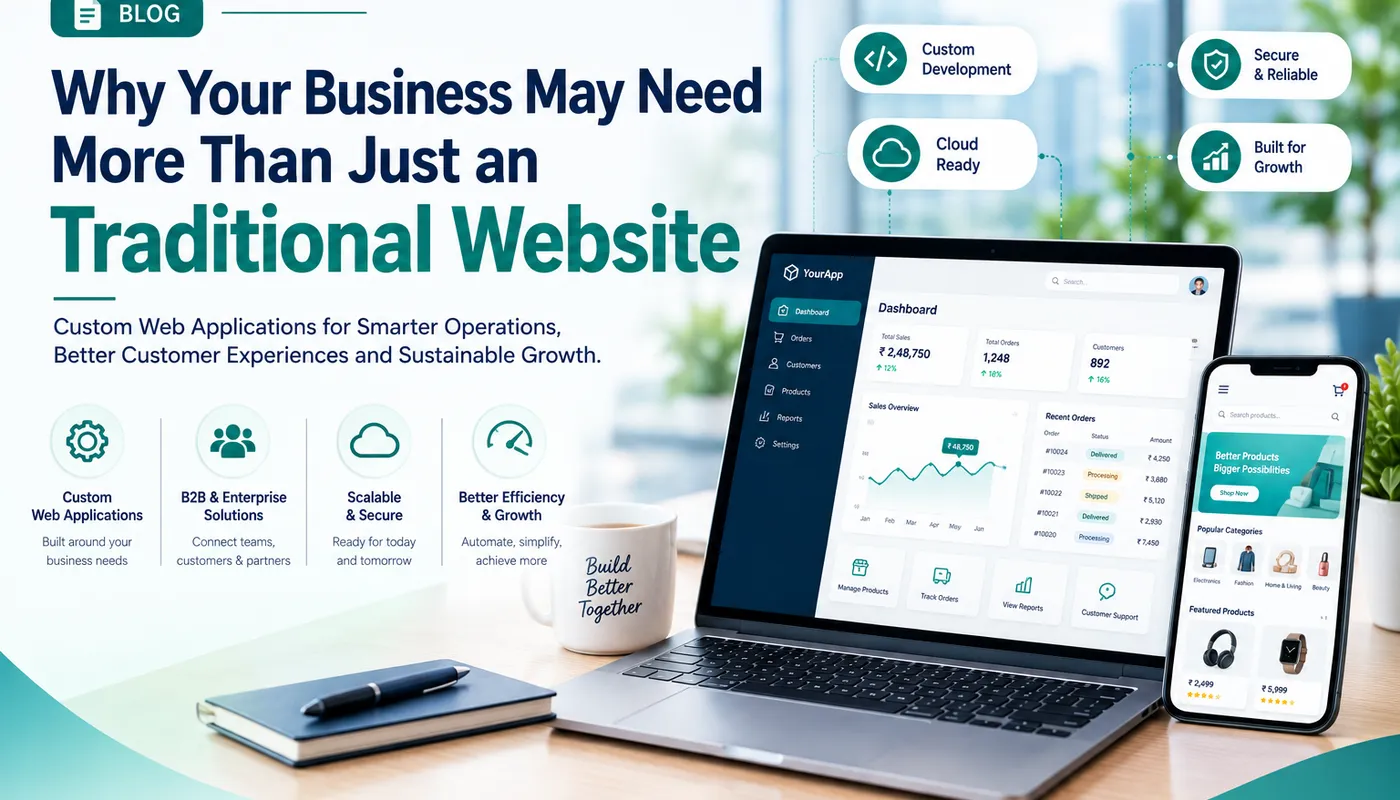
Why Your Business May Need More Than a Traditional Website
A traditional website is useful for presenting information about your company, services, products, contact details and brand.
But what happens when your business needs customers to log in, employees to manage tasks, teams to process approvals, managers to view reports, or different systems to exchange data automatically?
That is where a web application becomes more valuable than a standard website.
A web application can turn complicated business processes into structured digital workflows. Instead of depending on spreadsheets, emails, manual data entry or disconnected software, businesses can create one central system for managing important operations.
For example, a company may need a customer portal where clients can view orders and documents. An organisation may need an employee portal for leave and attendance management. A B2B company may need a dashboard for managing customers, quotations and sales activity.
These are not simply website requirements. They are business application requirements.
With the right web application development India partner, businesses can transform these requirements into secure, scalable and user-friendly digital solutions.
The important question is not simply, “Can we build a web app?”
It is:
“What business problem should the web application solve?”
What Is Web Application Development?
Web application development is the process of planning, designing, developing, testing, deploying and maintaining an interactive software application that users access through a web browser.
Unlike a basic informational website, a web application usually allows users to perform actions and interact with business data.
Examples include:
- Customer portals
- Employee portals
- CRM applications
- ERP applications
- SaaS platforms
- Admin dashboards
- Reporting systems
- Booking applications
- Workflow management systems
- B2B applications
- E-learning platforms
- Inventory systems
- Project management applications
A professional web application typically involves frontend development, backend development, database development, authentication, APIs, business logic, security, testing and deployment.
A custom web application development company India can therefore help businesses create software around their specific processes rather than forcing those processes into an unsuitable generic tool.
What Business Problems Can a Custom Web Application Solve?
The strongest reason to invest in custom web application development is to solve a specific operational or customer-facing problem.
Reduce Manual Work
If employees repeatedly copy information between spreadsheets, emails and different systems, a web application can automate many of those steps.
Centralise Business Data
Instead of storing information across disconnected files, a central application can provide controlled access to relevant business data.
Improve Workflow Management
Businesses can create automated workflows for approvals, task assignments, notifications, document processing and status updates.
Create Customer Portals
A customer portal can allow clients to log in and access information without repeatedly contacting employees.
For example:
Login → Dashboard → Orders → Documents → Support → Reports
Improve Reporting
An analytics or reporting dashboard can convert operational data into useful business information.
Managers may be able to monitor:
- Sales
- Orders
- Employee activity
- Project progress
- Customer activity
- Inventory
- Revenue
- Operational performance
Connect Existing Systems
API integration can connect the web application with CRM, ERP, payment, accounting, shipping or other third-party systems.
Support Business Growth
A well-designed application can provide a foundation for adding users, features, workflows and integrations as the business grows.
This is particularly valuable for organisations looking for scalable web applications rather than short-term solutions.
Our Web Application Development Solutions for Businesses
Every business application has different requirements. PrimeSource can support different types of web application development based on the business model and technical requirements.
Custom Web Applications
Custom web development allows the application to be designed around your processes.
Potential solutions include:
- Business management systems
- Workflow applications
- Customer portals
- Internal dashboards
- Data management platforms
- Custom CRM solutions
- Operations management applications
B2B Web Applications
B2B companies often require applications that support customers, suppliers, sales teams and internal operations.
A B2B application may include account-based access, quotations, order management, customer dashboards, reporting and document management.
Businesses searching for a B2B web application development company Bengaluru or other Indian technology hubs should evaluate providers based on their ability to understand business workflows—not just their coding capability.
Enterprise Web Portals
Large organisations may need enterprise web portal development services India for employees, customers, vendors or partners.
Enterprise applications can involve:
- Multiple user roles
- Role-based access
- Complex approval workflows
- Large databases
- Advanced reporting
- Enterprise integrations
- Security controls
- High availability requirements
SaaS Web Applications
Software-as-a-Service applications allow users to access software through the web, often through subscription-based models.
A SaaS application may require user onboarding, subscription management, dashboards, permissions, billing and analytics.
CRM and ERP Web Applications
Businesses can develop specialised CRM or ERP-style applications to manage customers, operations, inventory, sales, finance-related workflows or internal processes.
Workflow Automation Applications
If a process currently depends heavily on manual approvals, emails or spreadsheets, a custom workflow application can bring those activities into a structured system.
Custom Web Applications vs. Off-the-Shelf Software
Off-the-shelf software can be useful when your business requirements closely match the available functionality.
However, it may become limiting when your processes are unique.
Requirement
Off-the-Shelf Software
Custom Web Application
Setup
Usually faster
Requires planning and development
Customisation
Limited to available options
Built around requirements
Business workflows
Standardised
Highly flexible
Integrations
Depends on available APIs
Can be designed specifically
User experience
Predefined
Customisable
Scalability
Depends on vendor
Designed around business needs
Ownership/control
Vendor-dependent
Greater control over solution
The decision should not be based on the assumption that custom software is always better.
If an existing application solves your problem effectively, it may be the practical choice.
Custom development becomes more attractive when your business has unique processes, specialised workflows, integration requirements, or a product idea that cannot be supported effectively by existing software.
How We Build Web Applications Around Your Business Requirements
Professional application development starts before writing code.
1. Requirement Discovery
We first understand the business problem, users, workflows, data and expected outcomes.
Questions may include:
- Who will use the application?
- What problem does it solve?
- What tasks need to be automated?
- What information needs to be stored?
- Which systems need integration?
- What permissions are required?
- What reports are needed?
2. Application Architecture
The application architecture defines how different components will work together.
This may include the frontend, backend, database, APIs, authentication, integrations and hosting environment.
3. UI/UX Design
The interface should make complex processes understandable.
A well-planned web application UI/UX can improve usability and reduce training requirements.
4. Full-Stack Development
The frontend handles the user-facing experience while the backend manages business logic, data and server-side functionality.
5. Database Development
Application data needs to be structured appropriately for reliability, security and performance.
6. API and Third-Party Integration
Applications can connect to external systems through APIs where appropriate.
7. Testing and Quality Assurance
Testing helps identify functional, usability, compatibility, security and performance issues before launch.
8. Deployment
The completed application is deployed to its appropriate hosting or cloud environment.
9. Maintenance and Support
After launch, applications may require updates, monitoring, security improvements, bug fixes and new functionality.
Essential Features of a High-Performing Web Application
The exact features depend on the project, but several capabilities are common across professional applications.
User Authentication
Secure login and authentication help ensure that users access the appropriate application areas.
Role-Based Access
Different users may need different permissions.
For example:
Admin → Manager → Employee → Customer
Each role can have access to specific functionality.
Admin Dashboard
An admin dashboard can provide central control over users, content, settings, workflows and reports.
Data Management
Applications should provide structured ways to create, view, update and manage business information.
Automated Workflows
Automated workflows can reduce repetitive manual tasks.
Examples include:
Submission → Review → Approval → Notification → Completion
Search and Filtering
As application data grows, search and filtering become increasingly important for usability.
Reporting Dashboard
Businesses can use reporting dashboards to monitor operational and performance information.
API Integration
API integration can allow the application to communicate with external platforms.
Payment Gateway Integration
Where payments are required, appropriate payment gateway integration can be included.
Responsive Design
A responsive web application should work effectively across desktops, tablets and mobile devices where required.
Security
Security should be considered throughout development, including authentication, authorisation, data protection, input validation and appropriate access controls.
Full-Stack Web Application Development: What Does It Include?
Full-stack web application development India affordable solutions involve development across the major layers of an application.
Frontend Development
The frontend is what users interact with.
It includes:
- Interface design
- Navigation
- Forms
- Dashboards
- Tables
- Interactive components
- Responsive layouts
Backend Development
The backend handles business logic, processing, authentication, APIs and communication with databases and other systems.
Database Development
The database stores and manages application information.
Proper database design can support reliability, performance and scalability.
API Development
APIs allow different components and systems to communicate.
For example:
Web Application ↔ CRM ↔ Payment Gateway ↔ ERP
Cloud Application Development
Depending on requirements, applications can be deployed in cloud environments to support scalability, monitoring and operational flexibility.
A strong full-stack team understands how these components work together rather than treating frontend and backend development as completely separate activities.
Web Application Development for B2B Companies and Enterprises
B2B and enterprise organisations often have more complex workflows than consumer-facing businesses.
A B2B web application may support:
- Customer management
- Sales teams
- Quotations
- Orders
- Invoices
- Documents
- Approvals
- Account management
- Customer-specific pricing
- Reporting
An enterprise web application may involve multiple departments and user groups.
For example:
Employee → Manager → Department Head → Finance → Administration
Each stage can be structured within an application rather than handled through long email chains.
Enterprise applications also need to consider scalability, security, integrations, performance, user permissions and data management from the beginning.
This is where experienced enterprise web application development becomes important.
How Much Does Web Application Development Cost in India?
Businesses frequently ask, “How much does it get web application developed in India cost?”
The answer depends heavily on the project scope.
There is no reliable single price for every web application.
Factors that influence web application cost India include:
- Number of users
- Number of features
- UI/UX complexity
- Frontend requirements
- Backend architecture
- Database complexity
- Third-party integrations
- API development
- Authentication
- Role-based permissions
- Automation requirements
- Reporting
- Cloud infrastructure
- Security requirements
- Testing
- Maintenance and support
A simple internal application can have a very different scope from an enterprise platform serving thousands of users.
When requesting a web application development quotation, businesses should ask for a clear breakdown of:
Requirements + Features + Technology + Development + Testing + Deployment + Support
This makes it easier to understand what you are actually paying for.
Businesses searching for affordable web application development should also avoid choosing a provider based solely on the lowest quotation. A cheaper initial build may become expensive later if the application has poor architecture, limited scalability or inadequate testing.
Why the Right Development Team Matters for Your Web Application
A web application is not just a collection of screens.
It is a software system that needs to support real users and real business processes.
The right development team should understand:
Business Requirements
Developers should understand what the application is supposed to achieve.
Technical Architecture
The architecture should support the application's expected functionality and growth.
User Experience
Complex business functionality should still be simple for users to understand.
Security
Authentication, authorisation, data protection and secure development practices should be considered from the beginning.
Scalability
The application should be designed with future growth in mind.
Testing
Quality assurance helps ensure that functionality works as expected before and after deployment.
Long-Term Support
Applications evolve. Your development partner should be capable of supporting improvements after launch.
For companies considering a hire web app development team India offshore model, communication, documentation, project management and technical transparency are particularly important.
A remote or offshore development team can work effectively when requirements, responsibilities, milestones and communication processes are clearly established.
Why Choose PrimeSource for Web Application Development?
PrimeSource approaches web application development with a requirement-first mindset.
Instead of starting with a predefined solution, the focus is on understanding the business problem and then determining the appropriate application architecture and development approach.
PrimeSource can support businesses looking for:
- Custom web application development
- Full-stack web development
- B2B web applications
- Enterprise web portals
- SaaS applications
- Customer portals
- Employee portals
- Admin dashboards
- Workflow automation
- CRM and ERP integrations
- API development
- Cloud-based applications
- Responsive web applications
- Application testing
- Web application maintenance and support
For organisations looking to hire web application developers, the objective should be to find a team capable of combining technical implementation with business understanding.
Whether you are a startup with a new software idea, an SME trying to automate manual operations, a B2B organisation building a customer portal, or an enterprise modernising an existing system, PrimeSource can help turn your requirements into a practical digital solution.
FAQs
1. What is web application development?
Web application development is the process of creating interactive software that users access through a web browser. It can include frontend interfaces, backend systems, databases, APIs, authentication, business logic and integrations.
2. What is the difference between a website and a web application?
A website primarily presents information, while a web application allows users to interact with data and perform tasks such as submitting forms, managing records, processing orders, viewing dashboards or completing workflows.
3. Can you build a custom web application for my business?
Yes. Custom web applications can be designed around specific business processes, user roles, workflows, integrations and operational requirements.
4. Can a web application automate manual business processes?
Yes. Workflow automation can reduce repetitive tasks such as approvals, notifications, data entry, document processing and status updates.
5. Can web applications integrate with CRM and ERP systems?
Yes. Where appropriate APIs or integration methods are available, web applications can communicate with CRM, ERP, payment, shipping, accounting and other third-party systems.
6. How much does web application development cost in India?
The cost depends on the application's features, users, complexity, architecture, integrations, security, testing, deployment and support requirements. A proper quotation should be based on the defined project scope.
7. How long does it take to develop a web application?
The timeline depends on the complexity of the application. A smaller internal application may require significantly less development time than a complex enterprise platform with multiple integrations and user roles.
8. Can you develop an enterprise web portal?
Yes. Enterprise web portals can be developed with features such as role-based access, dashboards, workflows, reporting, document management, integrations and other enterprise requirements.
9. Can I hire a dedicated web application development team in India?
Yes. Businesses can work with a dedicated or remote development team depending on their project requirements, technical needs and preferred engagement model.
10. Can an existing web application be redesigned or upgraded?
Yes. Existing applications can be assessed for UI/UX improvements, performance, architecture, security, new functionality, integrations, migration or modernisation.
Let's Build a Web App That Solves Your Biggest Problem
Your business may already have a website.
But if your biggest challenge involves manual processes, disconnected systems, customer management, employee workflows, reporting, data management or complex business operations, a web application could provide a much more effective solution.
The right application can bring processes together, automate repetitive work, improve visibility and give customers or employees a better digital experience.
The starting point does not need to be a long technical specification.
Start with the problem.
What is slowing your business down?
What process takes too much manual effort?
What do your customers or employees need to do more easily?
PrimeSource can help turn those requirements into a practical, scalable and professional web application.
Whether you need custom web development, a B2B platform, enterprise web portal, SaaS application, customer portal, workflow automation system or dedicated development team, let's discuss what your business actually needs.
Let's Build a Web App That Solves Your Biggest Problem.
Contact PrimeSource to discuss your requirements, explore the right development approach, and request a web application development quotation tailored to your business.