Introduction
Choosing the right technology staffing model can influence your project timelines, operating costs, team productivity, and long-term business growth. When a company needs additional technical expertise, two common options are staff augmentation and IT outsourcing. Although both models help businesses access external talent, they differ in how professionals work with your team, who manages daily activities, and who takes responsibility for project delivery.
Understanding IT staff augmentation vs outsourcing helps business owners, CTOs, IT managers, and project leaders make informed decisions about resource allocation. The right choice depends on your internal capabilities, project requirements, budget, deadlines, and the level of control you want to maintain.
For example, a business with an established software development team may need two additional developers to complete a product faster. Staff augmentation can help extend its existing workforce. Another company may need an external partner to manage an entire software development project, making outsourcing a more suitable option.
At PrimeSource, businesses can explore IT staffing approaches that align with their technical requirements and workforce plans. Understanding the differences between these models is a practical first step towards choosing the right solution.
Quick Answer: Staff Augmentation vs Outsourcing
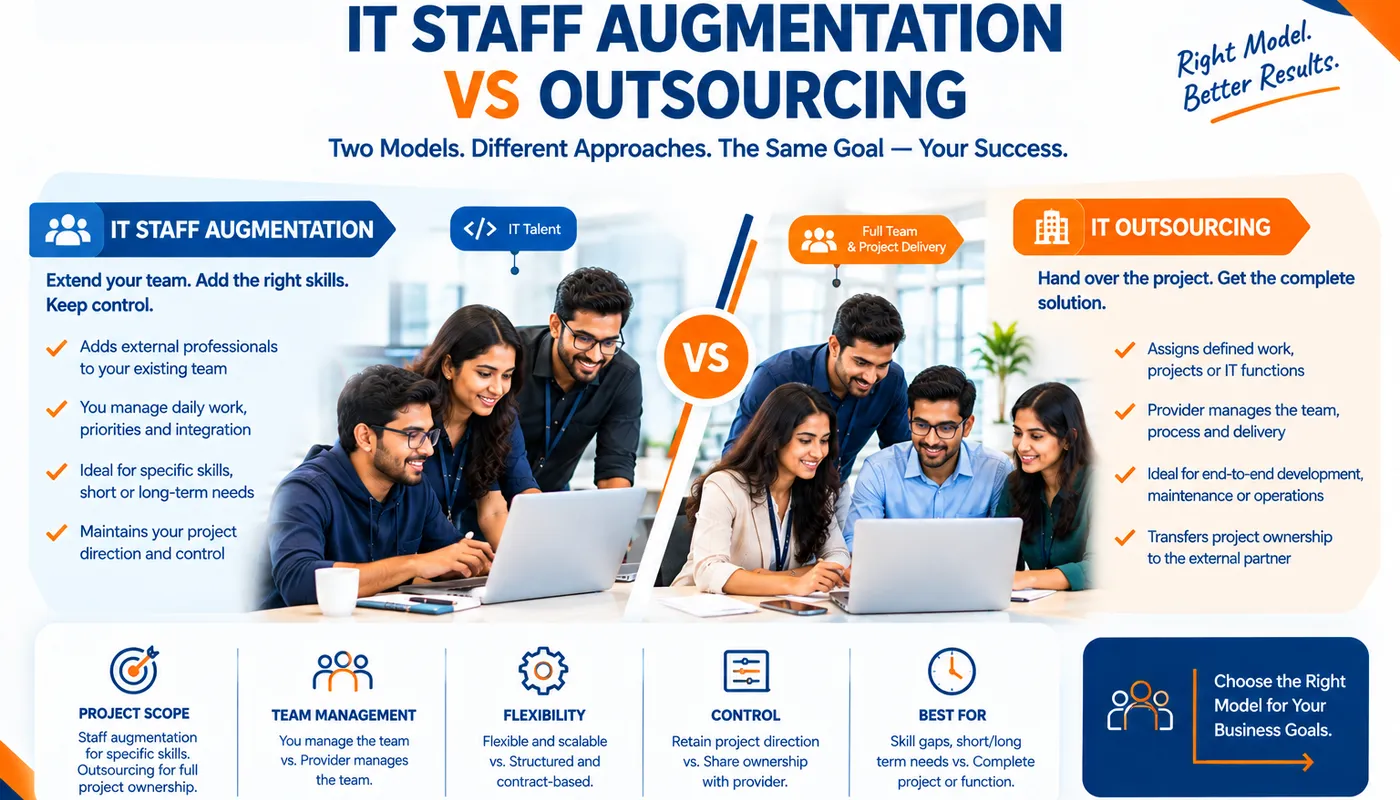
Staff augmentation adds external professionals to your existing team. Your organisation generally manages their day-to-day work, priorities, and integration into the project.
IT outsourcing involves assigning defined work, a project, or a technology function to an external provider. Depending on the agreement, the provider may manage the team, delivery process, and agreed outcomes.
The main difference is the allocation of management responsibility and project ownership. Staff augmentation extends your internal capabilities, while outsourcing transfers responsibility for specified work to an external partner.
1. What Is IT Staff Augmentation?
IT staff augmentation is a flexible staffing model in which a business brings external technical professionals into its existing team to meet specific skill or resource requirements.
Instead of hiring every professional as a permanent employee, a company can engage suitable talent for a defined period or project requirement. These professionals work alongside internal employees and contribute to the organisation's ongoing development activities.
For example, a company developing a mobile application might already have a project manager, UI/UX designer, and backend developers. If it needs additional Android expertise, it can use IT staff augmentation services in India to add an Android developer to the existing team.
The internal team continues to manage the project, while the augmented professional contributes specialist knowledge and development capacity.
Common Roles in Staff Augmentation
Depending on business requirements, staff augmentation may provide access to:
- Software developers
- Frontend and backend engineers
- Mobile application developers
- Quality assurance and testing professionals
- DevOps engineers
- Cloud specialists
- Data engineers and analysts
- Cybersecurity professionals
- Technical support specialists
- Business analysts
The specific roles, engagement duration, and responsibilities depend on the staffing agreement.
How Staff Augmentation Works
A typical engagement follows these steps:
- Identify the skill gap: Determine which technical skills or resources your existing team lacks.
- Define the requirements: Establish the required experience, responsibilities, project duration, and working arrangements.
- Source suitable professionals: Work with a staffing partner to identify candidates who match your requirements.
- Integrate the selected talent: Provide access to relevant tools, documentation, workflows, and team communication channels.
- Manage daily work: Your internal team typically assigns tasks, monitors progress, and manages priorities.
- Review performance: Evaluate contributions against agreed responsibilities and project needs.
Staff augmentation is particularly useful when a business has project management capabilities but needs additional technical expertise or development capacity.
2. What Is IT Outsourcing?
IT outsourcing is a business arrangement in which an organisation assigns specific technology work, a project, or an ongoing IT function to an external service provider.
Instead of adding individual professionals to its internal workforce, the business engages a provider to perform agreed services. The provider may supply its own team, project management, development processes, and delivery structure.
The precise responsibilities depend on the contract. Some outsourcing arrangements cover a complete software development lifecycle, while others focus on a defined activity such as application maintenance, testing, infrastructure support, or technical operations.
For example, a startup may have an idea for a customer-facing web application but lack an internal development team. It could engage a software development outsourcing provider to plan, build, test, and deliver the application according to an agreed scope.
Common IT Outsourcing Services
IT outsourcing services in India may cover:
- Custom software development
- Website and web application development
- Mobile application development
- Software testing and quality assurance
- Application maintenance and support
- Cloud infrastructure management
- IT helpdesk and technical support
- Cybersecurity services
- Database administration
- Business process outsourcing involving technology
The scope can range from a small, clearly defined assignment to a longer-term technology partnership.
How IT Outsourcing Works
A typical outsourcing arrangement includes:
- Define the project scope: Identify the business objectives, deliverables, requirements, and expected outcomes.
- Select a service provider: Evaluate relevant expertise, communication, delivery processes, and commercial terms.
- Agree on responsibilities: Document timelines, milestones, acceptance criteria, costs, and project governance.
- Begin project execution: The provider performs the agreed work using its delivery team and processes.
- Monitor progress: Both parties review milestones, risks, quality, and changes in scope.
- Accept the deliverables: The client reviews the completed work against the agreed criteria.
Outsourcing can be suitable for businesses that need an external team to manage defined responsibilities without building every capability internally.
3. IT Staff Augmentation vs Outsourcing: Key Differences
The difference between staff augmentation and outsourcing becomes clearer when you compare team structure, management, delivery responsibility, and flexibility.
Comparison Factor
IT Staff Augmentation
IT Outsourcing
Primary purpose
Extend your existing team
Delegate defined work or services
Team structure
External professionals integrate with your team
Provider generally supplies a separate delivery team
Daily management
Usually managed by your internal team
Usually managed by the provider for outsourced work
Project control
Greater direct control over tasks and priorities
Control is exercised through scope, milestones, governance, and agreements
Delivery responsibility
Internal team retains overall project leadership; responsibilities depend on the contract
Provider typically owns agreed deliverables or services
Skill access
Adds specific professionals or capabilities
Provides access to a team or service capability
Project management
Primarily handled internally
Often included in the provider's delivery model
Integration
Professionals work within existing workflows
Provider's team may work through separate processes
Resource flexibility
Useful for adjusting team capacity and skills
Useful for scaling a defined service or project engagement
Internal workload
Requires task assignment, coordination, and supervision
Can reduce internal execution and management workload
Cost structure
Often based on role, experience, duration, and engagement terms
May be based on milestones, project scope, recurring fees, or time and materials
Best suited for
Businesses with internal leadership and a team that needs extra expertise
Businesses seeking external ownership of defined work
Neither model is universally better. The right choice depends on whether your main challenge is a shortage of people or a need to delegate responsibility for delivering a service.
Team Integration and Operational Control
Staff augmentation gives your organisation more direct involvement in day-to-day execution. Augmented professionals can participate in internal meetings, follow existing development practices, and collaborate closely with employees.
With outsourcing, the external provider generally manages its own delivery process within the agreed scope. Your organisation still defines business goals, reviews progress, and makes important decisions, but it may have less direct involvement in daily task management.
Project Ownership and Delivery Responsibility
Staff augmentation is usually a better fit when your internal team wants to retain responsibility for architecture, priorities, product decisions, and delivery coordination.
Outsourcing can be more suitable when you want a provider to take responsibility for specific deliverables or a defined service. However, the provider's obligations depend on the contract, so responsibilities should be clearly documented before work begins.
Flexibility and Workforce Scalability
Staff augmentation allows businesses to add particular skills without necessarily changing their overall team structure. It can help address temporary skill gaps, workload increases, and short-term project demands.
Outsourcing allows businesses to expand their delivery capacity by engaging an external provider. It may be especially useful when the organisation does not want to establish an internal team for the entire scope of work.
4. How Does Cost Compare Between the Two Models?
Cost is an important consideration when evaluating IT staff augmentation vs outsourcing. However, comparing only hourly rates or project quotes can produce an incomplete picture.
The overall cost depends on the type of work, professional experience, engagement duration, management requirements, infrastructure, contractual terms, and the amount of work involved.
IT Staff Augmentation Cost in India
Staff augmentation costs may depend on:
- The professional's technical skills and experience
- The number of professionals required
- Engagement duration
- Working hours and time-zone requirements
- Contract type and commercial terms
- Recruitment, onboarding, and coordination requirements
- Internal management and supervision effort
This model can be cost-effective when your organisation already has the technical leadership and project management needed to direct the additional professionals.
However, your business must account for the time internal managers spend onboarding talent, assigning tasks, reviewing code, and coordinating delivery.
IT Outsourcing Costs
Outsourcing costs depend on the defined scope and the provider's delivery model. Common arrangements include:
- Fixed-price project agreements
- Time-and-materials billing
- Monthly service agreements
- Milestone-based payments
- Ongoing maintenance and support contracts
A fixed-price arrangement can make budgeting easier when requirements are clearly defined. If requirements change frequently, however, change requests may affect the final cost.
Time-and-materials agreements can offer more flexibility, but total spending may vary with the hours and resources required.
Which Model Offers Better Value?
Staff augmentation may offer better value when you need a small number of specialists and can manage their work effectively.
Outsourcing may provide better value when the provider can manage the entire scope efficiently and your organisation would otherwise need to build its own delivery capability.
For a fair cost comparison, evaluate the total cost of delivery rather than the quoted staffing rate alone. Include management time, onboarding, project coordination, quality assurance, tools, rework, and potential delays.
5. Advantages and Limitations of Staff Augmentation
Staff augmentation can give businesses greater control over technical execution, but it also requires active management.
Advantages
Access to specialised skills: Bring in technical expertise that may not be available within your existing workforce.
Flexible team expansion: Add capacity for a particular project or period without committing to a permanent position.
Direct project involvement: Keep internal leaders closely involved in priorities, technical decisions, and development workflows.
Knowledge retention: Augmented professionals can work directly with employees, allowing knowledge to remain within internal processes and documentation.
Support for tight timelines: Additional capacity can help address resource shortages, provided onboarding and project planning are handled effectively.
Limitations
Internal management is still necessary: Your team must allocate tasks, monitor progress, and resolve day-to-day issues.
Onboarding takes time: External professionals need access, documentation, context, and guidance before they can contribute effectively.
Integration requires planning: Different working habits or communication styles can create friction if expectations are unclear.
Availability can change: Contract terms and professional availability may affect continuity.
Internal leadership remains essential: Staff augmentation cannot replace missing product ownership or project management unless those responsibilities are separately agreed.
Staff augmentation is most effective when a business has clear technical leadership and a defined process for integrating external professionals.
6. Advantages and Limitations of IT Outsourcing
IT outsourcing can reduce the need to build an internal delivery team for every project. It can also give businesses access to capabilities that would be expensive or time-consuming to establish independently.
Advantages
Access to broader capabilities: Engage a provider with the skills and delivery structure required for a defined project.
Reduced internal execution workload: The provider can manage much of the agreed development or service delivery.
Defined deliverables: A well-structured agreement establishes what the provider must deliver and how completion will be assessed.
Potentially faster capability access: Businesses can use an established external team instead of recruiting every role individually.
Support for non-core activities: Outsourcing can free internal employees to focus on product strategy, customer relationships, or other priorities.
Limitations
Less direct daily control: Your organisation may have less influence over individual task assignments and the provider's internal processes.
Dependence on the provider: Delivery quality and timelines can be affected by the provider's capacity, communication, and performance.
Scope changes may affect costs: New requirements can lead to revised timelines, additional charges, or contract amendments.
Communication needs structure: Different teams, time zones, and approval processes may create coordination challenges.
Knowledge transfer requires planning: Your organisation should establish documentation, access, handover, and transition expectations to avoid unnecessary dependency.
Before outsourcing a critical project, assess the provider's capabilities, security practices, contractual terms, communication processes, and exit arrangements.
7. When Should You Choose Staff Augmentation?
Staff augmentation may be the right choice when your organisation already has a functioning team and needs additional people or specialist skills.
Consider this model if:
- Your project is managed internally.
- Your team has a temporary skill gap.
- You need additional developers, testers, or engineers.
- Your technical leaders want direct control over daily work.
- Your project requirements change frequently.
- You need to expand capacity without immediately making permanent hires.
- You want external professionals to follow your existing tools and workflows.
Example: Expanding an Existing Development Team
Imagine your company is preparing to release a new software product. Your current team understands the product architecture and business requirements, but it lacks sufficient testing capacity before launch.
Adding experienced QA professionals through staff augmentation may help increase testing capacity while keeping test priorities and release decisions within your organisation.
The model works because the business already has a project structure and needs additional execution capacity rather than a separate provider to own the entire delivery process.
8. When Is IT Outsourcing the Better Choice?
IT outsourcing may be appropriate when your business needs an external provider to deliver a defined project or manage a particular technology service.
Consider outsourcing if:
- You do not have an internal development team.
- You want to delegate a complete project or defined workstream.
- Your internal managers have limited time to supervise individual technical professionals.
- You need a combination of skills and delivery management.
- You prefer agreed milestones and deliverables.
- The work can be clearly scoped and assessed.
- You need ongoing maintenance or technical support from an external provider.
Example: Building a New Business Application
A company wants to develop an internal business application but does not have software developers, testers, or a technical project manager.
Rather than hiring each professional and building a delivery process, the company could engage an IT outsourcing provider to manage the agreed scope.
The business would still need to communicate its requirements, review progress, make key decisions, and approve deliverables. However, the provider would generally coordinate execution within the responsibilities defined in the agreement.
9. Dedicated Development Team vs Staff Augmentation
Businesses comparing staffing models may also consider a dedicated development team.
Although a dedicated team and staff augmentation both involve external professionals, their management arrangements can differ.
A dedicated development team is typically a group of professionals assigned to work on a client's product or ongoing development requirements. Depending on the arrangement, the provider may manage the team, while the client contributes product direction and strategic priorities.
With staff augmentation, individual professionals generally join and work within the client's existing team structure.
Factor
Staff Augmentation
Dedicated Development Team
Team structure
Adds professionals to the internal team
Provides a dedicated group of professionals
Daily management
Usually handled by the client
May be handled by the provider or shared
Internal leadership
Client typically directs daily execution
Client provides goals and product direction; responsibilities vary
Best use case
Filling specific skill or capacity gaps
Supporting ongoing development with a dedicated external team
Integration
Professionals join existing workflows
The team may work within agreed shared or separate workflows
Commercial model
Often based on roles and engagement duration
Often based on team composition and engagement duration
A dedicated team is not automatically the same as full outsourcing. The distinction depends on who manages delivery, how the team is structured, and which responsibilities the provider accepts.
Review the proposed operating model carefully rather than relying on the service label alone.
10. How to Choose the Right IT Staffing Model
Before choosing between staff augmentation and outsourcing, assess your business objectives and delivery capabilities.
Step 1: Identify Your Main Requirement
Ask whether you need more people to execute existing plans or an external partner to take responsibility for defined work.
If your internal team knows what needs to be done but lacks capacity, staff augmentation may fit. If you need a provider to plan and deliver an agreed scope, outsourcing may be more appropriate.
Step 2: Evaluate Internal Management Capabilities
Consider whether your organisation has the technical leadership, project management, and communication processes needed to direct external professionals.
Staff augmentation typically requires more direct involvement from your internal managers. Outsourcing can reduce that workload for the outsourced scope, although client oversight remains necessary.
Step 3: Review the Project Scope
Projects with changing requirements may benefit from a model that supports frequent collaboration and adjustments.
Projects with clearly defined deliverables may be easier to outsource under a well-structured scope and acceptance process.
Step 4: Compare Total Costs
Compare the complete cost of each model, including professional fees, project management, onboarding, infrastructure, quality assurance, and change requests.
A lower initial quote does not necessarily mean a lower total cost.
Step 5: Assess Security and Intellectual Property
Determine how the provider or external professionals will access company systems, source code, customer information, and confidential documents.
Establish appropriate access controls, confidentiality obligations, intellectual property terms, data-handling practices, and offboarding procedures before work begins.
Step 6: Define Accountability
Make sure every important responsibility has a clear owner.
Document who will manage daily tasks, approve technical decisions, resolve issues, monitor timelines, accept deliverables, and handle changes in requirements.
Step 7: Consider Long-Term Requirements
If your business expects ongoing product development, decide how technical knowledge, documentation, and continuity will be maintained.
The best model should support your current project while remaining practical for future workforce planning.
11. How PrimeSource Can Support Your IT Staffing Needs
Selecting a technology staffing model is not simply about finding professionals. It is about matching the engagement structure to your internal capabilities, project requirements, and business objectives.
PrimeSource can be considered as a staffing partner when your organisation is evaluating its IT resource requirements and looking for an appropriate approach to team expansion.
Depending on the services agreed, IT staffing support may help businesses address technical skill gaps, source relevant professionals, and plan flexible workforce requirements.
Before selecting any provider, clarify the following:
- Which technical roles do you need?
- What skills and experience are essential?
- How long will the engagement last?
- Who will manage the professionals?
- What are the expected responsibilities and deliverables?
- How will performance and communication be handled?
- What commercial and contractual terms apply?
- How will knowledge transfer and offboarding work?
If your business already has an internal development team, staff augmentation may help you add the specific skills or capacity required. If you need a provider to manage a defined project, an outsourcing arrangement may be more suitable.
PrimeSource encourages businesses to evaluate these differences carefully so they can choose a staffing approach that supports effective execution, clear accountability, and sustainable growth.
12. Frequently Asked Questions
1. What is the main difference between IT staff augmentation and outsourcing?
Staff augmentation adds external professionals to your existing team, with your organisation typically managing their daily work. IT outsourcing assigns defined work or services to an external provider, which generally manages execution within the agreed scope.
2. Is staff augmentation better than IT outsourcing?
Neither model is always better. Staff augmentation is often suitable when you have internal project leadership but need more technical capacity. Outsourcing may be preferable when you want an external provider to deliver a defined project or service.
3. Is IT staff augmentation cost-effective in India?
It can be cost-effective when you need specific technical skills and already have the management structure to guide the professionals. Total costs depend on experience, engagement duration, contract terms, onboarding, and internal supervision.
4. What are IT outsourcing services in India?
IT outsourcing services in India can include software development, application maintenance, testing, technical support, infrastructure management, and other technology services. The exact scope depends on the provider and the agreement.
5. Can staff augmentation support short-term projects?
Yes. Staff augmentation can support short-term technical requirements when suitable professionals are available and the engagement terms meet the project's needs. It can also support longer-term team expansion.
6. Who manages staff augmentation professionals?
In a typical staff augmentation arrangement, the client manages daily tasks, priorities, and project workflows. The staffing provider's responsibilities may include sourcing, contractual administration, or other agreed support.
7. Does outsourcing mean losing control of a project?
No. Outsourcing changes how execution is managed, but the client retains control over business objectives, requirements, approvals, and contractual governance. The level of operational control depends on the agreement.
8. What is the difference between a dedicated development team and staff augmentation?
Staff augmentation generally adds individual professionals to an existing team. A dedicated development team provides a group of professionals assigned to a client's development requirements, with management responsibilities determined by the engagement model.
9. How do I choose an IT staff augmentation company in India?
Evaluate technical expertise, candidate suitability, communication, engagement flexibility, contractual transparency, security practices, and the provider's ability to understand your workforce requirements. Confirm management responsibilities and commercial terms before proceeding.
10. Can a business combine staff augmentation and outsourcing?
Yes. A business may augment its internal team for core product development while outsourcing a separate project, testing activity, or maintenance function. Clear ownership, communication, and contractual boundaries are important when combining models.
Conclusion
Understanding IT staff augmentation vs outsourcing helps businesses select a technology staffing model that fits their actual needs rather than choosing based on cost or convenience alone.
Staff augmentation is generally suited to organisations that want to extend their internal teams, fill skill gaps, and retain direct involvement in daily execution. IT outsourcing is often appropriate when a business wants an external provider to manage defined work, deliverables, or technology services.
Find the Right IT Staffing Model for Your Business with PrimeSource
Not sure whether staff augmentation or outsourcing is the better fit for your business?
Start by identifying your technical skill gaps, project requirements, delivery responsibilities, and preferred level of operational control. With a clearer understanding of your needs, you can evaluate the right staffing approach for your organisation.
Connect with PrimeSource to discuss your IT staffing requirements and explore a suitable approach to building or extending your technology team.