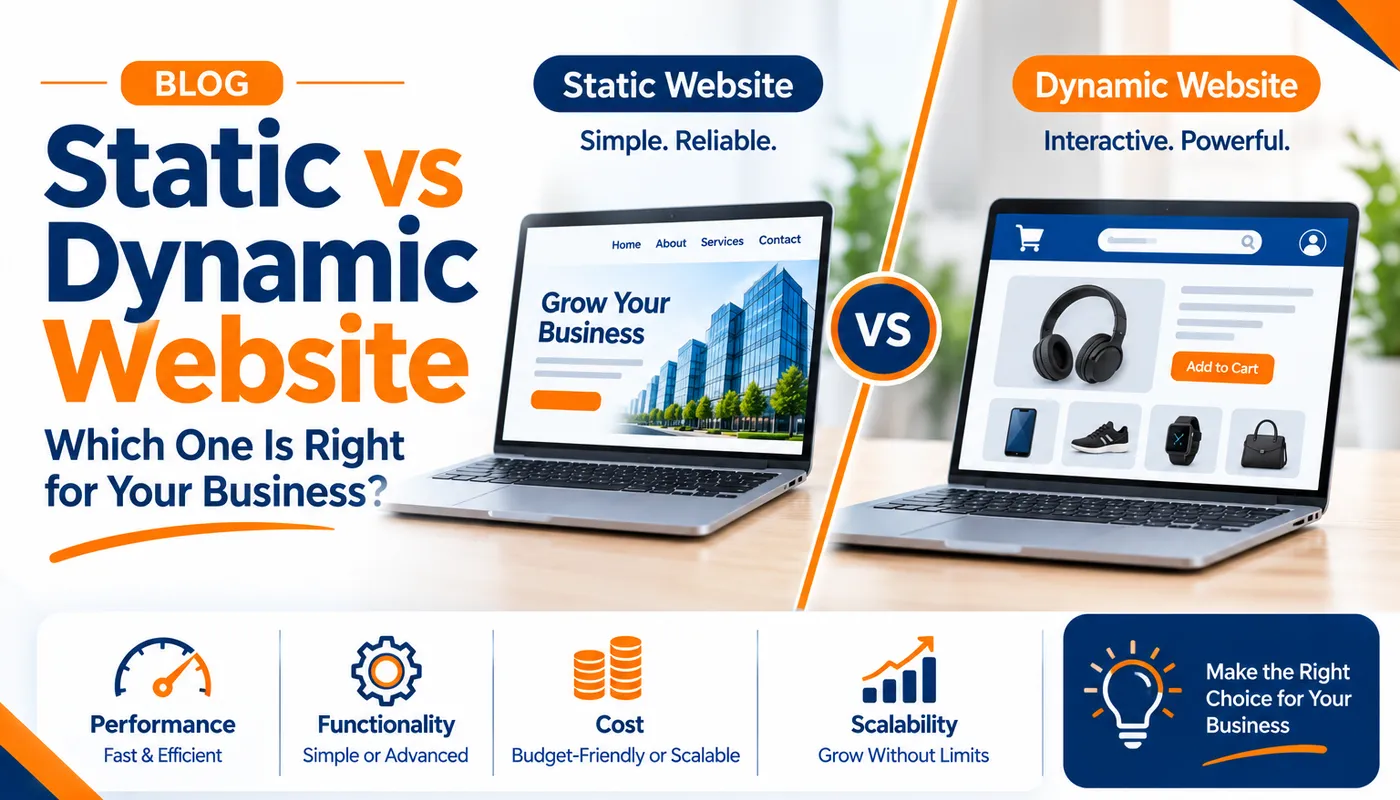
Planning to build a website for your business? One of the first decisions you will need to make is whether to choose a static or dynamic website.
A website is more than an online address. It represents your business, introduces your services, communicates with customers and supports your digital marketing activities. However, choosing the wrong website structure can create difficulties with content updates, functionality, maintenance and future growth.
Understanding static vs dynamic website development helps you select an approach that matches your business requirements. A small business that needs a few informational pages may not require the same website functionality as an e-commerce company managing hundreds of products.
Both website types have their advantages. Static websites can be suitable for simple, content-focused online experiences, while dynamic websites support more interactive features, frequent content updates and database-driven functionality.
Before investing in website development, it is important to understand how these options work and what they mean for your business.
PrimeSource encourages businesses to evaluate their goals, expected functionality and long-term plans before choosing a website development approach.
3. Featured Snippet Answer
A static website displays pre-built web pages with content that generally remains the same until someone updates the website files. A dynamic website can generate or update content using databases, server-side technologies and content management systems. Static websites suit simpler online requirements, while dynamic websites are useful for interactive, frequently updated and feature-rich websites.
4. Table of Contents
- What Is a Static Website?
- What Is a Dynamic Website?
- Static vs Dynamic Websites — Key Differences
- Advantages and Disadvantages of Static Websites
- Advantages and Disadvantages of Dynamic Websites
- Static vs Dynamic Website: Which Is Better for SEO?
- Static vs Dynamic Website Development Cost in India
- Which Website Type Is Right for Your Business?
- Factors to Consider Before Choosing a Website Development Approach
- Common Mistakes to Avoid
- How PrimeSource Can Help You Choose the Right Website Solution
- Conclusion
5. Main Article
What Is a Static Website?
A static website is a website made up of pre-built web pages that are delivered to visitors in their prepared form. The content generally remains the same for every visitor unless the website files are manually changed or updated through a deployment process.
Static websites commonly use technologies such as HTML and CSS, along with JavaScript where required.
For example, imagine a local consultancy that needs a website containing five pages:
- Home
- About Us
- Services
- Portfolio
- Contact
If the content does not change frequently and visitors mainly need information about the business, a static website may be sufficient.
How Does a Static Website Work?
When a visitor opens a static website, the browser requests the relevant page from the web server. The server delivers the prepared files, which the browser displays.
The website does not need to generate every page using a database for each request.
This relatively straightforward architecture can make static websites easier to deploy and maintain when their functionality is limited.
Key Characteristics of Static Websites
- Pre-built HTML and CSS pages.
- Content usually remains consistent between visitors.
- Limited dependence on databases.
- Content changes generally require file updates or a publishing workflow.
- Suitable for straightforward informational websites.
- Can be hosted using relatively simple hosting arrangements.
When Are Static Websites Useful?
Static website development India can be suitable for businesses that need a simple online presence.
Examples include:
- Small business websites.
- Personal portfolios.
- Landing pages.
- Event information websites.
- Basic company profile websites.
- Informational microsites.
However, if your business needs customer accounts, frequently updated product listings, booking systems or other interactive features, a static-only approach may require additional development.
What Is a Dynamic Website?
A dynamic website generates or updates content using application logic, databases and other technologies. Unlike a basic static website, its content and functionality can change depending on user activity, stored information or administrative updates.
Dynamic websites are commonly built using server-side technologies, databases and client-side scripting.
For example, consider an e-commerce website. Customers should be able to browse products, search categories, add items to a shopping cart, create accounts and place orders.
These features require more than displaying fixed web pages. The website needs to process information and respond to user actions.
How Does a Dynamic Website Work?
A dynamic website can retrieve information from a database, process a visitor's request and generate the appropriate content.
A typical process may involve:
- A visitor opens a webpage.
- The browser sends a request to the website server.
- The server processes the request.
- Relevant information may be retrieved from a database.
- The website generates or updates the requested content.
- The browser displays the result.
The exact architecture depends on the technologies and development approach used.
Role of Content Management Systems
A content management system (CMS) allows authorised users to create, edit and manage website content through an administrative interface.
CMS-based website development can be useful for businesses that regularly publish:
- Blog articles.
- News and announcements.
- Service updates.
- Product information.
- Portfolio projects.
- Landing pages.
A CMS can reduce the need for developers to manually edit website files whenever routine content changes are required.
Interactive Features and Personalisation
Dynamic website development India can support features such as:
- User registration and login.
- Contact and enquiry forms.
- Search functionality.
- Product catalogues.
- Shopping carts.
- Online payments.
- Booking systems.
- Customer dashboards.
- Content filtering.
- Third-party integrations.
These capabilities make dynamic websites suitable for businesses that need visitors to interact with the website rather than simply read information.
Static vs Dynamic Websites — Key Differences
The difference between static and dynamic websites becomes clearer when comparing their architecture, content management, functionality and maintenance requirements.
Comparison Factor
Static Website
Dynamic Website
Content
Generally fixed until updated
Can change based on data or user actions
Architecture
Pre-built web pages
Often uses application logic and databases
Development
Usually simpler for basic requirements
Can involve more complex development
Content updates
Often require file changes or deployment
Can be managed through a CMS or admin panel
Functionality
Suitable for straightforward features
Supports more complex interactive features
Loading speed
Can be very fast when well optimised
Depends on server processing and optimisation
Database
Not normally required for basic content
Often uses databases
Maintenance
Often simpler for small websites
May require application, database and plugin maintenance
Scalability
Can scale effectively for content delivery
Can support growing functionality and business operations
Security
Fewer server-side components in basic implementations
Requires attention to application, database and access security
Technical requirements
Relatively straightforward
Depends on the platform and required features
Best suited for
Informational websites and simple landing pages
Portals, e-commerce websites and interactive platforms
Neither option automatically provides better results. The right choice depends on the website's purpose, content requirements, expected traffic and future functionality.
Advantages and Disadvantages of Static Websites
Static websites offer several practical benefits, particularly when a business needs a straightforward website without complex functionality.
Advantages of Static Websites
1. Potentially Fast Loading
Static pages can be delivered directly without generating content from a database for every request. With suitable hosting, caching and image optimisation, this can support fast website performance.
2. Simpler Architecture
A basic static website may require fewer technical components than a database-driven application. This can make deployment and maintenance more straightforward.
3. Fewer Server-Side Components
A static website without complex server-side functionality has fewer application components that need to be secured and maintained.
4. Suitable for Simple Business Requirements
Businesses that mainly need to introduce their services, display contact information and establish an online presence may find static websites practical.
5. Predictable Content Presentation
Since pages are generally pre-built, businesses can maintain consistent layouts and content across their website.
Disadvantages of Static Websites
1. Content Updates Can Require Technical Support
When a website does not include a suitable content management system, even simple changes may require someone familiar with the website files and publishing process.
2. Limited Built-In Interactivity
Advanced features such as customer dashboards, product management and personalised experiences require additional functionality.
3. More Difficult Content Management at Scale
Managing a large number of pages manually can become time-consuming.
4. Additional Development for Advanced Features
If business requirements change, adding complex functionality may require significant redevelopment.
Static websites are therefore best considered when the required functionality is clearly defined and expected to remain relatively simple.
Advantages and Disadvantages of Dynamic Websites
Dynamic websites offer greater flexibility for businesses that need regular content updates, user interaction and custom functionality.
Advantages of Dynamic Websites
1. Easier Content Management
A suitable CMS allows authorised users to update website content without editing every page manually.
2. Advanced Website Functionality
Dynamic websites can support customer accounts, product catalogues, search systems, booking platforms and other interactive features.
3. Database Integration
Database-driven websites can store and retrieve information such as products, customer records, orders and content.
4. Greater Content Flexibility
Different pages and sections can display information based on stored data, user activity or administrative settings.
5. Support for Business Growth
A dynamic architecture can be designed to accommodate additional features and changing business requirements.
6. Third-Party Integrations
Depending on the development approach, dynamic websites can integrate with payment gateways, CRM systems, marketing platforms and other business tools.
Disadvantages of Dynamic Websites
1. More Complex Development
Dynamic website development can involve front-end interfaces, server-side scripting, databases, integrations and application logic.
2. Maintenance Requirements
Businesses may need to maintain the CMS, plugins, frameworks, database and server environment.
3. Security Responsibilities
Dynamic websites require appropriate protection for user accounts, databases, forms, application components and administrative access.
4. Performance Depends on Optimisation
Database queries, scripts, plugins and server processing can affect website loading speed if they are not managed properly.
5. Potentially Higher Development Costs
The cost can increase when the website requires custom functionality, complex integrations or specialised development.
Dynamic websites offer flexibility, but they need an appropriate development and maintenance plan.
Static vs Dynamic Website: Which Is Better for SEO?
A common question businesses ask is whether static or dynamic websites are better for search engine optimisation.
The answer is that neither website type automatically ranks better. Search visibility depends on content quality, technical implementation, website performance, mobile usability, crawlability and other SEO factors.
Website Loading Speed
Loading speed affects the visitor experience. Static pages can be quick to deliver, but dynamic websites can also achieve strong performance through caching, optimised databases, efficient code and suitable hosting.
Mobile Responsiveness
Both website types should work properly across smartphones, tablets and desktop screens.
Responsive web design helps ensure that visitors can access content and use website features across different screen sizes.
Crawlability and Indexing
Search engines need to access and understand website content.
Both static and dynamic websites can be crawlable when pages are accessible, internal links work correctly and important content is available to search engines.
Dynamic websites should be configured carefully so important content is not hidden behind inaccessible interactions or technical restrictions.
Content Management and Publishing
Businesses that publish blogs, service updates and educational resources frequently may benefit from CMS-based website development.
A CMS can make content management more convenient, but SEO performance still depends on the quality and optimisation of published pages.
URL Structure and Technical Optimisation
An SEO-friendly website should use clear URLs, logical navigation, descriptive page titles, relevant meta descriptions and appropriate internal links.
The website should also have a suitable sitemap, correct indexing settings and properly implemented structured data where relevant.
The best approach is to select a website architecture that supports your business requirements while allowing effective technical SEO.
Static vs Dynamic Website Development Cost in India
Website development cost India depends on more than whether a website is static or dynamic.
The final cost can vary according to design requirements, number of pages, functionality, development technology, integrations, hosting and ongoing maintenance.
Static Website Development Cost Factors
Static website development may involve:
- Number of pages.
- Design complexity.
- Responsive layouts.
- Content preparation.
- Contact forms or other basic features.
- Hosting and domain requirements.
- Future content update arrangements.
A straightforward business website may require fewer development components than a feature-rich application.
Dynamic Website Development Cost Factors
Dynamic website development may involve additional requirements such as:
- CMS installation and configuration.
- Database design.
- Custom application functionality.
- User registration and login.
- Admin dashboards.
- E-commerce functionality.
- Payment gateway integrations.
- Third-party software integrations.
- Security and maintenance requirements.
A custom website development India project with advanced functionality will generally require more planning and development effort than a basic informational website.
Which Option Is More Affordable?
A simple static website may have a lower initial development cost when compared with a dynamic website offering similar visual presentation.
However, cost should be evaluated against the features and future requirements of the business.
If your company expects to publish regular content, manage products or introduce customer-facing features, choosing a suitable dynamic solution from the beginning may be more practical than repeatedly rebuilding a basic website.
Request a scope-based estimate that considers both initial development and ongoing maintenance.
Which Website Type Is Right for Your Business?
The right website depends on what you want visitors to do and how you expect your business to grow.
Small Businesses and Local Service Providers
A small business that mainly needs to display its services, business information, contact details and location may find a static website sufficient.
If the business regularly updates service information or publishes articles, a CMS-based dynamic website may be more convenient.
Startups
Startups should consider their immediate product requirements and future plans.
A simple landing page or company profile may work well as a static website. However, a startup developing an online platform, customer portal or application may need a dynamic solution.
Corporate Websites
Corporate websites often include multiple service pages, company information, news, careers and other regularly updated content.
A dynamic website with a suitable CMS can make content management easier, particularly when several authorised team members need to publish updates.
Blogs and Content-Based Websites
Blogs and publishing platforms generally benefit from content management capabilities.
A CMS-based dynamic website can help authors create articles, organise categories, manage images and publish content regularly.
E-Commerce Businesses
An e-commerce business typically needs product management, customer accounts, shopping carts, checkout, payment integration and order management.
These requirements usually call for a dynamic website or e-commerce platform.
E-commerce website development India should therefore be planned around product volume, customer experience, payment requirements and future business operations.
Portfolio and Landing Page Websites
A personal portfolio, campaign landing page or small project showcase may work effectively as a static website when the content and functionality are limited.
The objective is to avoid unnecessary complexity while still providing a professional user experience.
Factors to Consider Before Choosing a Website Development Approach
Before selecting a website type, evaluate these practical factors.
1. Budget: Consider the initial development cost along with hosting, updates, maintenance and future improvements.
2. Content Update Frequency: If your team regularly changes products, services, articles or announcements, a CMS may be useful.
3. Required Functionality: Identify whether visitors need to register, make payments, submit applications, book appointments or interact with stored information.
4. Website Traffic Expectations: Choose suitable hosting and architecture based on expected visitors and the website's performance requirements.
5. Scalability: Consider whether the website may need additional pages, features, integrations or user accounts in the future.
6. Security: Evaluate the security requirements of the website, particularly if it stores customer information or processes transactions.
7. Maintenance: Understand who will handle updates, backups, troubleshooting and technical support.
8. Future Business Plans: Your website should support your business direction rather than only meeting today's minimum requirements.
Common Mistakes to Avoid When Choosing a Website Type
Choosing a website architecture without considering practical requirements can create unnecessary costs and development challenges.
Avoid these common mistakes:
- Choosing only based on initial cost: A low-cost option may not support your future requirements.
- Ignoring scalability: Consider whether the website can accommodate new features and content as the business grows.
- Overlooking security: Every website needs appropriate security measures for its architecture and functionality.
- Selecting unnecessary features: Avoid paying for complex functionality that does not support your current business objectives.
- Ignoring mobile responsiveness: A professional website should provide a consistent experience across devices.
- Treating SEO as an afterthought: Plan for crawlability, page structure, content optimisation and performance during development.
- Not planning maintenance: Define who will manage updates, backups, content and technical issues after launch.
A clear requirement document can help prevent these problems before development begins.
How PrimeSource Can Help You Choose the Right Website Solution
Choosing between static and dynamic website development requires an understanding of your business, target audience and technical requirements.
PrimeSource provides website development solutions for businesses looking to establish or improve their online presence. The right approach should begin with understanding what the website needs to achieve.
For example, a company that needs a straightforward informational website may benefit from a simpler development approach. A business that requires content management, customer interaction, e-commerce functionality or custom integrations may need a more flexible dynamic solution.
When planning a website, important considerations include:
- Business goals and target audience.
- Required pages and website structure.
- Design and responsive web design requirements.
- Content management needs.
- Custom website functionality.
- Third-party integrations.
- Website performance and security.
- Future scalability and maintenance.
By evaluating these requirements before development, businesses can make a more informed decision about their website architecture.
PrimeSource helps businesses explore website development services India based on their online presence and functionality requirements, with an emphasis on choosing an approach that supports practical business needs.
Conclusion
Understanding static vs dynamic website development is an important step when planning a new business website or upgrading an existing one.
Static websites can be suitable for simple, content-focused requirements where pages do not need frequent changes. Dynamic websites offer greater flexibility for businesses that require content management, database-driven information, interactive features and custom functionality.
However, neither approach is automatically the right choice for every business. Your decision should depend on your budget, content requirements, expected functionality, maintenance capacity and future plans.
A website should support your business objectives, provide a good user experience and allow room for growth.
PrimeSource helps businesses evaluate website development requirements and explore suitable solutions based on their goals and technical needs.
6. Key Takeaways
- Static websites use pre-built pages that generally remain unchanged until updated.
- Dynamic websites can generate or update content using databases and application logic.
- Static websites are suitable for simple informational websites and landing pages.
- Dynamic websites support CMS functionality, e-commerce and interactive features.
- Neither website type automatically performs better in search rankings.
- Website development costs depend on design, functionality, integrations and maintenance.
- Businesses should consider future scalability before selecting a website architecture.
- The right choice depends on business objectives and practical website requirements.
7. Frequently Asked Questions
1. What is the main difference between static and dynamic websites?
A static website displays pre-built pages that generally remain the same until updated. A dynamic website can generate content using databases and application logic, allowing more interactive features and flexible content management.
2. Is a static website better than a dynamic website?
Not necessarily. Static websites can suit simple informational requirements, while dynamic websites are more appropriate for businesses that need frequent content updates, customer accounts, e-commerce or other interactive functionality.
3. Which website type is more affordable?
A basic static website may cost less to develop because it can require fewer technical components. Dynamic website costs depend on the CMS, database, custom functionality, integrations and maintenance requirements.
4. Are dynamic websites better for SEO?
Not automatically. Both static and dynamic websites can perform well in search results when they have useful content, good loading performance, mobile responsiveness, crawlable pages and appropriate technical SEO.
5. Can a static website be converted into a dynamic website?
Yes. A static website can be redesigned or rebuilt to include a CMS, database and dynamic functionality. The approach depends on the existing website structure and the features required.
6. Which website type is suitable for small businesses?
A static website may be suitable for a small business that only needs basic company and service information. A dynamic website may be more useful if the business needs regular content updates, booking features or customer interactions.
7. Is WordPress a static or dynamic website platform?
WordPress is generally considered a dynamic content management system because it uses a database and application logic to manage and deliver website content. However, static versions of WordPress websites can also be generated using additional tools and workflows.