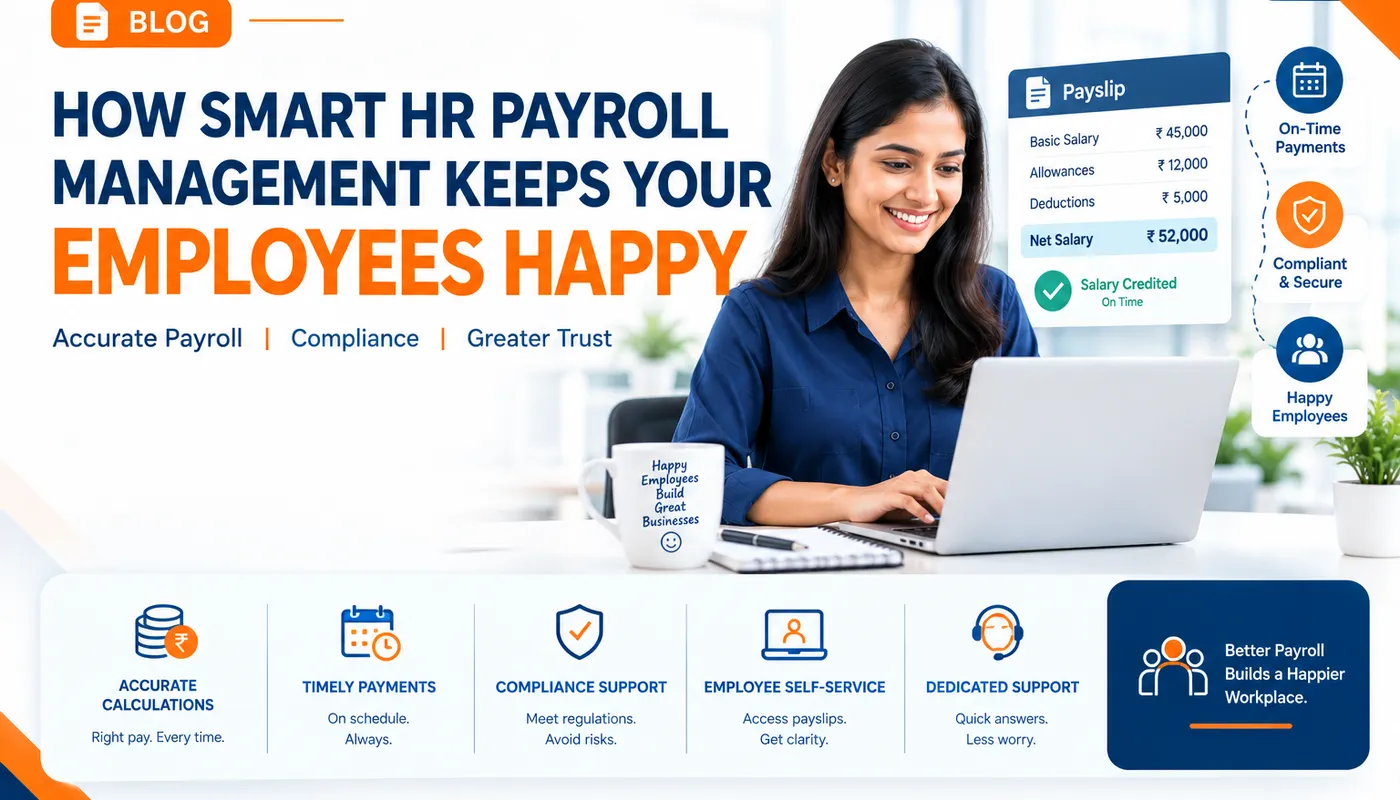
How Smart HR Payroll Management Keeps Your Employees Happy
Salary day is one of the most important moments in an employee's working month. Employees expect their salary to arrive on time, deductions to be understandable, payslips to be accurate, and any payroll concern to be resolved without unnecessary delays.
That is why payroll management India is more than an administrative responsibility. The way a company manages payroll can directly influence employee trust, financial confidence, workplace morale and overall satisfaction. A small payroll error may be corrected quickly, but repeated mistakes can make employees question the reliability of their employer.
For growing Indian businesses, smart HR payroll management combines accurate processing, appropriate technology, compliance practices, secure employee data handling and responsive payroll support. When these elements work together, payroll becomes a reliable part of a positive employee experience.
How Does HR Payroll Management Keep Employees Happy?
Effective HR payroll management keeps employees happy by ensuring salaries are calculated accurately, paid on time, deductions are transparent and payslips are reliable. It also provides a clear process for resolving payroll questions, reducing uncertainty and building employee trust in the organisation.
What Is HR Payroll Management?
HR payroll management is the process of managing employee compensation accurately and consistently. It typically covers the activities required to calculate salaries, apply appropriate deductions, generate payslips, maintain payroll records, support statutory compliance and produce payroll reports.
A typical payroll workflow may include:
- Collecting employee and attendance information
- Validating leave and attendance records
- Calculating gross and net salary
- Applying approved deductions and adjustments
- Processing statutory deductions where applicable
- Generating payslips
- Maintaining payroll records
- Preparing payroll reports
- Supporting employee payroll queries
- Reviewing payroll before final processing
For businesses searching for payroll management India solutions, the objective should not simply be to process salaries. A good payroll process should create accuracy, transparency and consistency for both employees and the organisation.
Why Payroll Management Matters to Employee Happiness
Employees may not see the entire payroll workflow, but they immediately notice its outcome.
When salaries are processed accurately and on schedule, employees have greater confidence in their employer. Clear payslips also help employees understand their earnings, deductions and other compensation components.
Smart payroll management supports employee satisfaction through:
Timely Salary Payments
Employees depend on their salary for household expenses, financial commitments and personal planning. Consistent salary processing reduces unnecessary financial uncertainty.
Accurate Salary Calculations
Errors in basic salary, allowances, deductions, overtime or other approved components can create frustration. Accurate salary calculation demonstrates that employee compensation is being handled carefully.
Transparent Deductions
Employees should be able to understand why deductions appear on their payslips. Clear documentation can reduce confusion and unnecessary HR queries.
Faster Resolution of Payroll Issues
Even well-managed payroll systems can encounter exceptions. What matters is having a defined process for investigating and resolving them.
Greater Employee Trust
Payroll is closely connected with employee trust because it concerns something highly personal: compensation. Reliable payroll administration signals that the organisation takes its commitments seriously.
How Payroll Errors Affect Employee Trust
Payroll processing errors can happen because of incorrect employee data, manual calculations, attendance mismatches, outdated salary information or inadequate review processes.
Common issues include:
- Incorrect salary calculations
- Missing allowances
- Incorrect deductions
- Delayed salary payments
- PF-related errors
- ESI-related errors
- TDS calculation issues
- Incorrect payslips
- Attendance mismatches
- Leave calculation errors
Consider an employee whose approved leave was incorrectly recorded as unpaid leave. Even if the mistake is eventually corrected, the employee may experience unnecessary stress while waiting for clarification.
Repeated errors can increase HR workload while affecting employee morale, engagement and confidence. This is why payroll accuracy should be treated as an employee-experience priority rather than only a finance task.
Key Features of Effective HR Payroll Management
A reliable payroll workflow generally includes:
- Accurate payroll processing
- Timely salary payments
- Automated calculations where appropriate
- Attendance and leave integration
- Payslip generation
- Payroll reporting
- Employee self-service options
- Compliance management
- Secure payroll records
- Clear payroll documentation
- Payroll support and query management
The right combination depends on the size and structure of the organisation. A startup with a small team may require a simpler workflow, while a growing company may need integrated HR technology, automated payroll processing and stronger reporting capabilities.
How Payroll Automation Improves Employee Experience
Manual payroll work can involve repetitive data entry, calculations and cross-checking. As employee numbers increase, managing these activities manually can become more difficult.
Payroll automation India solutions can help businesses streamline repetitive tasks such as salary calculations, deductions, payslip generation and reporting.
For example, an automated payroll processing company India SMEs approach may integrate employee records, attendance and leave information before payroll is processed. This can reduce unnecessary manual work and provide a more consistent payroll workflow.
Automation can support:
- Faster payroll processing
- Consistent calculations
- Automated deductions
- Faster payslip generation
- Better payroll records
- Easier reporting
- Reduced administrative workload
- Faster identification of exceptions
Automation does not eliminate every payroll error. Incorrect employee information, wrong configurations or inaccurate input data can still affect results. Human review and appropriate controls remain important.
Cloud-Based Payroll Management: What Businesses Should Know
A cloud-based payroll management solution India businesses use can allow authorised users to access payroll information through a secure online environment rather than relying entirely on locally stored systems.
Potential advantages include:
- Centralised payroll data
- Remote accessibility for authorised users
- Easier reporting
- Integration with HR systems
- Scalable workflows
- Employee access to payslips and relevant information
- Support for automated payroll processes
However, cloud adoption should not be based on convenience alone. Businesses should evaluate access controls, authentication, data protection, backup practices, audit capabilities and vendor security processes before selecting a payroll platform.
Payroll data contains confidential employee information, so payroll data security should always be part of technology selection.
Payroll Compliance in India
Payroll compliance can involve several statutory and tax-related responsibilities. Depending on the organisation and employee circumstances, relevant areas may include Provident Fund (PF), Employees' State Insurance (ESI), Tax Deducted at Source (TDS), salary-related deductions, payroll records and applicable reporting or filing requirements.
Businesses looking for statutory compliance payroll services India company support should ensure that the provider understands the regulatory requirements relevant to their workforce.
Similarly, PF ESI TDS payroll compliance India should not be treated as a one-size-fits-all process. Applicable obligations can vary based on employee category, salary structure, organisation, location and prevailing regulations.
Businesses should therefore verify current requirements through appropriate government or regulatory sources and obtain professional advice where necessary.
Outsourced Payroll Management for Businesses
Payroll outsourcing involves engaging an external provider to handle some or all payroll-related activities on behalf of the business.
Outsourced payroll management services for companies India businesses may use can include:
- Salary processing
- Payroll calculations
- Payslip management
- Payroll records
- Compliance support
- Payroll reporting
- Payroll administration
- Employee payroll query support
- Data handling and process coordination
Outsourcing can be particularly useful when internal HR or finance teams are spending significant time on repetitive payroll administration or do not have sufficient payroll expertise.
The level of outsourcing can vary. Some businesses may outsource only processing, while others may seek broader payroll administration and compliance support.
Benefits of Outsourcing Payroll
Professional payroll outsourcing can help businesses:
- Reduce repetitive administrative workload
- Standardise payroll processes
- Access payroll specialists
- Improve process consistency
- Strengthen compliance support
- Scale payroll operations as the workforce grows
- Give HR teams more time for strategic activities
- Establish clearer payroll administration workflows
Outsourcing does not remove the need for internal oversight. Businesses should still define responsibilities, approval processes, data-access controls and escalation procedures.
How Professional Payroll Management Supports SMEs
Payroll becomes more complex as an SME grows.
A business that once managed a small number of employees may eventually have different salary structures, attendance patterns, benefits, deductions and compliance responsibilities.
An automated payroll processing company India SMEs can work with may help establish a more structured payroll workflow as the workforce expands.
For SMEs, the important question is not simply whether payroll can be processed internally. It is whether the existing process remains accurate, secure, compliant and manageable as business requirements change.
How Payroll Management Supports HR Teams
Payroll administration can consume considerable HR time when processes depend heavily on manual work and repeated employee queries.
An effective payroll process allows HR teams to spend more attention on:
- Recruitment
- Employee engagement
- Performance management
- Learning and development
- Retention
- Workforce planning
- Employee relations
- Strategic HR initiatives
This creates a healthier division between routine administration and strategic HR work.
PrimeSource approaches payroll management as part of the broader employee and workforce experience, with a focus on reliable processes, payroll accuracy and practical HR support.
How to Choose a Payroll Management Company in India
When evaluating a payroll company India businesses can consider, look beyond the advertised price.
Use this checklist:
- Payroll expertise: Does the provider understand your payroll structure and workforce?
- Compliance knowledge: Can it support applicable statutory and tax-related requirements?
- Accuracy controls: What review and validation processes are used?
- Technology: Does the platform support automation and reporting?
- Integration: Can attendance, leave or HR systems be connected where required?
- Data security: How is confidential employee information protected?
- Scalability: Can the process support workforce growth?
- Employee support: Is there a clear process for payroll queries?
- Reporting: Can the business receive useful payroll reports?
- Pricing transparency: Are processing, implementation and additional service charges clearly explained?
- Responsiveness: How are payroll exceptions and urgent issues handled?
- Business experience: Has the provider worked with organisations with similar payroll requirements?
The right payroll management company should be evaluated on reliability, process quality and business fit—not simply on the lowest quote.
Payroll Management for Businesses in Bengaluru and Chennai
Major technology and corporate hubs such as Bengaluru and Chennai have businesses with diverse workforce structures and fast-changing hiring needs.
A payroll management company Bengaluru for IT firms may need to handle different employee categories, variable compensation structures, attendance inputs and evolving workforce requirements.
Similarly, companies searching for outsourced payroll services Chennai corporate businesses can use should assess compliance knowledge, technology, support responsiveness and scalability.
Local searches such as payroll company near me Bangalore may help businesses discover providers, but location alone should not determine the final choice. The quality of payroll processes, security controls, expertise and support model are more important considerations.
PrimeSource can be evaluated alongside other providers based on the organisation's actual payroll requirements rather than assumptions about location or business size.
What Does Payroll Management Cost in India?
There is no single payroll management price that applies to every business.
The cost of payroll services may depend on:
- Number of employees
- Payroll frequency
- Salary structure complexity
- Compliance requirements
- Number of locations
- Technology integrations
- Level of outsourcing
- Reporting requirements
- Employee support requirements
- Implementation or transition needs
Businesses considering an outsource payroll India company quote now approach should provide enough information for the provider to understand the actual scope.
A useful quotation should clearly explain what is included, what requires additional charges and which responsibilities remain with the client.
How to Improve Payroll Management in Your Business
Businesses can strengthen payroll processes by taking these practical steps:
- Standardise payroll processes and document responsibilities.
- Maintain accurate employee records and update changes promptly.
- Integrate attendance and leave data where appropriate.
- Automate repetitive calculations while retaining review controls.
- Review payroll before final processing to identify unusual results.
- Maintain a compliance calendar for relevant obligations.
- Secure payroll data through appropriate access controls.
- Provide clear payslips so employees understand their compensation.
- Create a payroll query process with clear ownership and response procedures.
- Review payroll performance regularly using errors, queries, processing time and reconciliation results as internal measures.
Expert Tips for Better Payroll Management
Payroll specialists generally benefit from focusing on process discipline rather than relying entirely on software.
Keep employee information updated, validate attendance and leave inputs, review salary changes before payroll, maintain clear deduction records and protect confidential employee data.
It is also useful to reconcile payroll regularly and document how exceptions are handled. If an employee raises a payroll concern, the response should be traceable from the original input through calculation and final correction.
Technology can improve efficiency, but strong payroll governance remains essential.
Common Payroll Management Mistakes
Businesses should watch for mistakes such as:
- Manual data entry without validation
- Outdated employee information
- Poor attendance integration
- Incorrect deductions
- Missing compliance checks
- Delayed payroll processing
- Weak payroll data security
- Inconsistent payroll processes
- Poor communication with employees
- Lack of payroll review and reconciliation
The solution is usually a combination of better processes, appropriate automation, employee-data discipline and clearly assigned responsibilities.
Conclusion
Payroll may happen behind the scenes, but employees experience its results directly. Accurate salary calculations, timely payments, understandable deductions and dependable support can strengthen employee trust and reduce avoidable workplace frustration.
For Indian businesses, effective payroll management India practices should balance payroll accuracy, compliance, security, technology and employee experience. Whether payroll is managed internally, automated through software or supported by an external provider, the goal should remain the same: create a reliable and transparent payroll process.
When payroll works smoothly, HR teams can spend less time resolving preventable issues and more time supporting people and business growth.
Simplify Your HR Payroll Management with PrimeSource
A reliable payroll process gives employees greater confidence while helping HR and finance teams manage payroll administration more efficiently.
PrimeSource provides professional HR and payroll management solutions designed to support accurate payroll processing, compliance-related workflows and a smoother employee experience.
If your organisation is reviewing its current payroll process, considering automation or exploring professional payroll support, discuss your requirements with PrimeSource and identify an approach suited to your workforce.