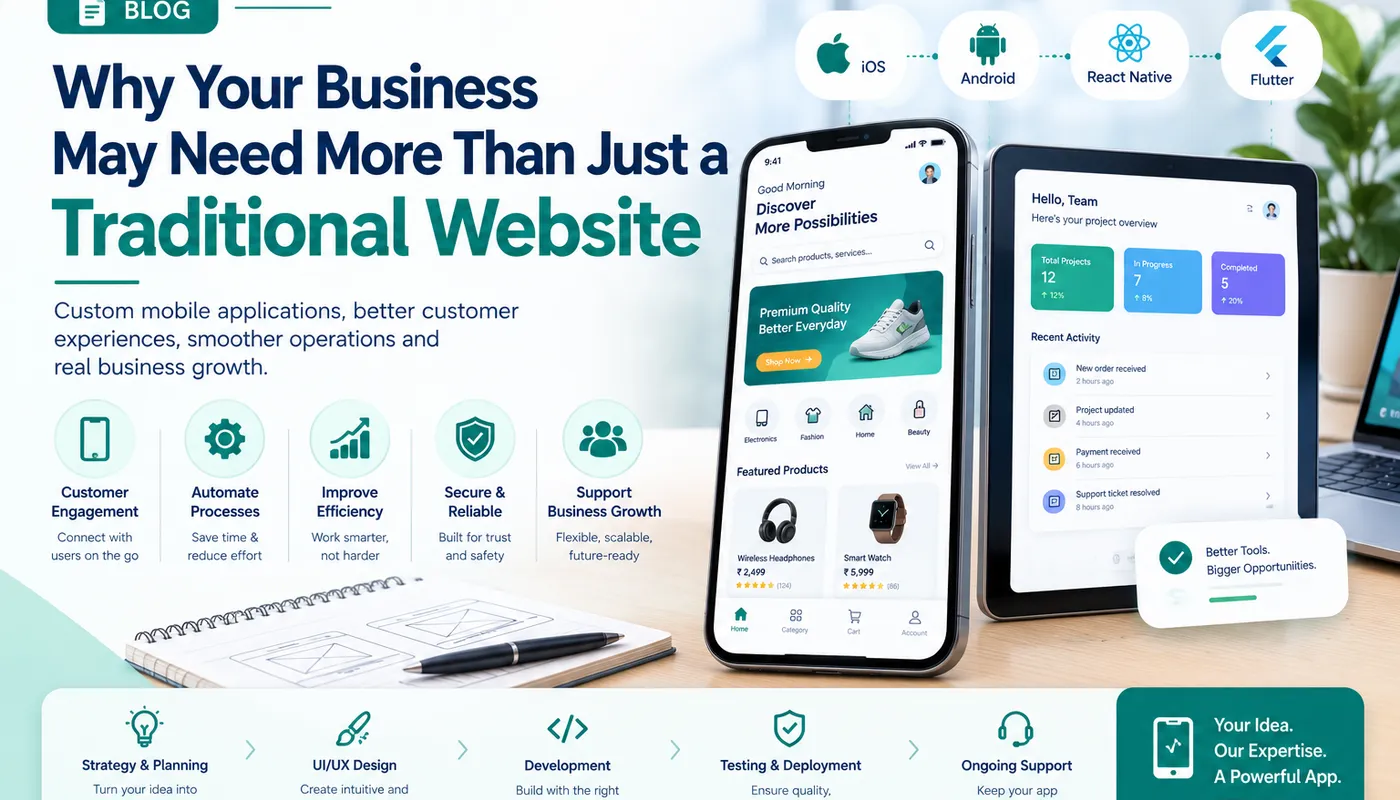
Why Your Business May Need a Mobile App
Your customers are already using their smartphones to search, shop, communicate, make payments, book services and manage their everyday activities.
So if your business has an idea that could make one of those experiences easier, faster or more convenient, a mobile application may be the right digital product to build.
A mobile app can do much more than provide another way for customers to contact your business.
It can help customers place orders, manage accounts, make payments, track services, receive notifications, communicate with your team or access personalised information.
For businesses, mobile applications can also improve internal processes.
An employee mobile app could help field teams update information from anywhere. A sales application could provide customer and order information while representatives are travelling. A service business could allow customers to schedule appointments and receive real-time updates.
That is why mobile app development India is not simply about writing code for Android or iOS.
It starts with understanding the problem the app needs to solve.
The strongest mobile products are built around a clear purpose, a defined audience and a practical user journey.
If you already have an app idea, the next step is turning that idea into a product that people can actually use.
From App Idea to Reality: What Does Mobile App Development Involve?
Mobile application development is the process of transforming an idea or business requirement into a functional mobile product.
It can involve:
Idea → Validation → Product Strategy → UI/UX → Development → Testing → Deployment → Analytics → Updates
The process begins by understanding what you want the application to accomplish.
For example, you may want to:
- Launch a new digital product
- Sell products through mobile commerce
- Digitise an existing service
- Automate customer interactions
- Build a marketplace
- Create an employee application
- Launch a fintech solution
- Build a healthcare application
- Extend an existing web platform
- Create an on-demand service
The development team then determines the appropriate technology, features, architecture and user experience.
A professional mobile application development company should therefore be involved in more than coding. Product planning, usability, security, testing, deployment and ongoing support are all important parts of the process.
Our Mobile App Development Services for Businesses
Different businesses need different mobile solutions. PrimeSource can support mobile application development based on your business model, audience and technical requirements.
iOS App Development
iOS applications can be developed specifically for Apple's mobile ecosystem.
Businesses targeting iPhone and iPad users may choose native iOS development when platform-specific performance and functionality are important.
Android App Development
Android provides access to a broad range of devices and users.
An experienced Android app developer India can build applications designed around Android functionality, device compatibility and the requirements of the target audience.
Cross-Platform App Development
Cross-platform development allows businesses to build applications that can run across iOS and Android using a shared development approach.
This can be useful when businesses want to reach both platforms while managing development resources efficiently.
React Native Development
React Native can be considered for businesses looking for cross-platform applications with a shared codebase and native platform capabilities.
Flutter App Development
Flutter is another cross-platform technology that can be suitable for businesses looking to develop applications for multiple platforms.
Businesses considering React Native Flutter app development services India should select the framework based on project requirements rather than choosing a technology simply because it is popular.
Custom Mobile App Development
Custom mobile application development can be used for specialised business requirements that cannot be effectively handled through standard applications.
On-Demand Applications
Businesses in delivery, transportation, home services, bookings and other industries may require on-demand app development services India.
These applications can include:
- Customer registration
- Service selection
- Booking
- Location tracking
- Payments
- Notifications
- Order/service status
- Ratings and reviews
Industry-Specific Applications
Mobile applications can also be developed for sectors such as:
- Fintech
- Healthcare
- Ecommerce
- Education
- Logistics
- Retail
- Professional services
- Manufacturing
For example, fintech app development company India searches may come from businesses planning payment, financial management or investment-related applications, while healthcare businesses may require secure patient-facing or provider-facing mobile solutions.
iOS vs. Android vs. Cross-Platform App Development
Choosing the development approach is an important early decision.
Approach
Advantages
Suitable For
Native iOS
Platform-specific optimisation and capabilities
iOS-focused products
Native Android
Android-specific functionality and optimisation
Android-focused products
React Native
Shared development approach across platforms
Startups and businesses targeting both
Flutter
Cross-platform development with flexible UI
Businesses requiring multi-platform apps
Native development can provide greater control over platform-specific functionality.
Cross-platform development can help businesses reach multiple platforms through a shared development approach.
The right choice depends on:
- Target audience
- Budget
- Required functionality
- Performance expectations
- Development timeline
- Existing technology
- Future roadmap
- Platform-specific requirements
A good development partner should explain the trade-offs rather than automatically recommending one technology for every project.
React Native and Flutter: When Should You Choose Cross-Platform Development?
Cross-platform development can be attractive for businesses that need both iOS and Android applications.
Instead of maintaining completely separate application codebases, technologies such as React Native and Flutter allow teams to share significant portions of the development effort.
This can be useful for:
- Startups
- SMEs
- MVP development
- Customer-facing applications
- Ecommerce applications
- Business applications
- SaaS mobile products
However, cross-platform does not mean every project should use it.
Native development may be more appropriate when the application depends heavily on platform-specific capabilities or specialised performance requirements.
The decision should therefore be based on the product roadmap.
For startups, cross-platform development can also be useful when validating an idea before making larger investments.
The objective is to choose a development approach that balances cost, speed, performance, functionality and future scalability.
Essential Features of a Successful Business Mobile App
A mobile application's features should support the user journey rather than simply make the app look technically impressive.
User Registration and Authentication
Users may need email, phone, social login or other appropriate authentication options.
User Profiles
Customer profiles can store relevant account information and preferences.
Push Notifications
Push notifications can help businesses communicate order updates, reminders, offers, alerts and other relevant information.
Search and Navigation
Good navigation helps users find features and information quickly.
Payment Gateway Integration
For ecommerce, subscriptions, bookings and other transactional applications, mobile payment integration can provide convenient purchasing experiences.
API Integration
APIs allow the application to communicate with backend systems and third-party services.
GPS and Location Services
Location-based services can be useful for delivery, transportation, logistics, field services and location-aware applications.
Real-Time Notifications
Applications requiring live status updates can use real-time communication where appropriate.
Analytics
App analytics can help businesses understand user behaviour, engagement, retention and conversion.
Security
Mobile app security should be considered throughout development, particularly when applications handle personal, financial or business information.
Scalable Architecture
The application should be designed with future growth in mind.
This can include increasing users, transactions, data, integrations and functionality.
How Mobile App UI/UX Design Influences User Engagement
A technically strong application can still fail if users find it confusing.
Mobile app UI/UX design should make the experience intuitive.
Consider a simple customer journey:
Open App → Login → Find Product → View Details → Add to Cart → Pay → Receive Confirmation
Every unnecessary step creates friction.
Good mobile user experience considers:
- App navigation
- Screen hierarchy
- Touch-friendly controls
- Clear calls-to-action
- Readable content
- Consistent interface patterns
- Error handling
- Loading states
- Search and filters
- Accessibility
- Mobile performance
The first few interactions are particularly important.
Users should quickly understand what the application does and where they should go next.
For ecommerce applications, this could mean helping users discover products and complete purchases.
For a service application, it may mean allowing users to book a service within a few simple steps.
For an employee application, it may mean making frequently used workflows immediately accessible.
The design should follow the user's purpose.
Mobile App Development for Startups, SMEs and Enterprises
Startups
Startups often begin with an idea rather than a complete product specification.
The development process can therefore include app idea validation, MVP planning, feature prioritisation and product strategy.
The objective is to build enough functionality to test the core concept without unnecessarily increasing initial development complexity.
SMEs
Small and medium businesses may use mobile applications to digitise services, improve customer engagement or automate operations.
An affordable mobile app development company India SME businesses can work with should focus on practical features and measurable business objectives.
D2C Brands
D2C businesses can use mobile applications to provide personalised shopping experiences, notifications, loyalty features and mobile commerce.
Ecommerce Businesses
Ecommerce applications can provide product discovery, shopping carts, payments, order tracking, customer accounts and notifications.
Enterprises
Enterprise mobile applications may support employees, customers, field teams, partners and internal operations.
They may require advanced authentication, API integration, CRM integration, ERP integration, reporting and enterprise security.
A scalable approach becomes particularly important when an application is expected to support a large number of users.
How Much Does Mobile App Development Cost in India?
One of the first questions businesses ask is:
“How much does it cost to develop a mobile app in India?”
There is no single answer because every application has a different scope.
A mobile app development cost can be influenced by:
- Number of platforms
- Native vs cross-platform development
- Number of screens
- UI/UX complexity
- Backend requirements
- Database architecture
- APIs
- Payment integration
- GPS functionality
- Real-time features
- User roles
- Admin dashboards
- Third-party integrations
- Security requirements
- Testing
- Deployment
- Maintenance
A basic business application can have very different requirements from a fintech platform, marketplace or enterprise application.
When requesting a develop mobile app India cost estimate, businesses should provide as much information as possible about the required features and target platforms.
A proper app development quotation should clearly explain:
Scope + Features + Platforms + Technology + Development + Testing + Deployment + Support
This helps businesses compare proposals based on actual requirements instead of comparing only headline prices.
Businesses looking for affordable app development should also consider long-term costs. Poor architecture, weak security, limited scalability or inadequate testing can create additional expenses after launch.
How We Turn Your App Idea Into a Scalable Product
A good app idea needs a structured path from concept to launch.
Step 1: Understand the Idea
We begin by understanding your business objective, target audience and the problem the application should solve.
Step 2: Define the Core Features
Not every possible feature needs to be included in the first version.
The initial scope should focus on the features that deliver the most value.
Step 3: Plan the User Journey
We define how users move through the application.
For example:
Registration → Dashboard → Action → Confirmation → Notification
Step 4: Design the Interface
The application UI/UX is designed around usability, branding and the intended user experience.
Step 5: Select the Technology
The appropriate approach—native, React Native, Flutter or another suitable architecture—is selected based on the project.
Step 6: Develop the Application
Frontend, backend, database, APIs and integrations are developed according to the approved requirements.
Step 7: Test
Quality assurance covers functionality, usability, compatibility, performance and relevant security considerations.
Step 8: Deploy
The application can then be prepared for App Store deployment and Google Play Store deployment, depending on the platforms selected.
Step 9: Monitor and Improve
After launch, analytics and user feedback can help identify areas for improvement.
App development does not necessarily end at launch. Regular updates, maintenance, performance optimisation and security improvements can help keep the product useful over time.
How to Choose the Right Mobile App Development Company in India
Choosing an app development company India businesses can trust requires more than reviewing a portfolio.
Look at Relevant Experience
Ask whether the team has worked on applications similar to yours.
Evaluate Technical Capability
Check experience across iOS, Android, React Native, Flutter, APIs, databases and backend systems as relevant to your project.
Review UI/UX Skills
A development company should understand the relationship between design and user behaviour.
Ask About Security
If your application handles personal, financial or business information, security should be discussed from the beginning.
Understand the Development Process
Ask how requirements, design, development, testing, deployment and support will be managed.
Discuss Scalability
Your development team should understand where the application needs to go in the future.
Ask About Post-Launch Support
Mobile applications require updates and maintenance as operating systems, devices and business requirements change.
Request a Transparent Estimate
A detailed proposal should explain the scope, technology, features, timeline, development cost and support model.
If you are comparing options using searches such as best app development company India 2026 reviews, remember that reviews are only one factor. Technical experience, communication, project fit and long-term support are equally important.
Why Choose PrimeSource for Mobile App Development?
PrimeSource approaches mobile application development around the product and business requirement rather than simply the technology.
The objective is to help businesses transform ideas into professional mobile products that are practical, scalable and easy for users to navigate.
Depending on the project, PrimeSource can support:
- iOS app development
- Android app development
- Cross-platform app development
- React Native development
- Flutter app development
- Custom mobile application development
- Mobile app UI/UX
- API integration
- Payment integration
- CRM and ERP integration
- GPS and location-based functionality
- App testing and quality assurance
- App Store and Google Play deployment
- App maintenance and support
This makes PrimeSource a practical option for businesses looking to build an app for my business India now, whether they are starting from an idea or improving an existing application.
The process starts with understanding your business problem, target users, required functionality and growth plans.
From there, the right technology and development approach can be selected.
FAQs
1. How do I turn my app idea into a real product?
Start by defining the problem, target users and core functionality. A development team can then help with product planning, UI/UX, technology selection, development, testing and deployment.
2. Can you develop both iOS and Android applications?
Yes. Applications can be developed for iOS and Android using native or cross-platform development approaches depending on project requirements.
3. Should I choose React Native or Flutter?
Both can be suitable for cross-platform development. The appropriate choice depends on the application's functionality, team requirements, integrations, performance expectations and long-term roadmap.
4. How much does mobile app development cost in India?
The cost depends on features, platforms, design complexity, backend requirements, integrations, security, testing and support. A detailed project scope is needed for an accurate estimate.
5. Can you develop a mobile app for a startup?
Yes. Startup app development can begin with an MVP focused on the core functionality needed to validate the product and gather user feedback.
6. Can you build fintech or healthcare mobile applications?
Mobile applications can be developed for specialised industries, but the exact requirements depend on the application's functionality, integrations, security needs and applicable industry requirements.
7. Can a mobile app integrate with an existing website or software?
Yes. API integration can connect mobile applications with existing websites, databases, CRM systems, ERP platforms and other software where suitable integration methods are available.
8. Can you build an ecommerce mobile application?
Yes. Ecommerce mobile applications can include product catalogues, search, shopping carts, payments, customer accounts, order tracking, notifications and other required functionality.
9. Do you provide app maintenance after launch?
Mobile app maintenance can include updates, bug fixes, performance improvements, security updates, compatibility work and new functionality.
10. Can I hire a dedicated mobile app development team in India?
Yes. Businesses can work with a dedicated or remote app development team depending on project scope, required expertise and preferred engagement model.
Got an App Idea? Let's Make It a Reality
Your app idea may have started with a simple thought:
“There has to be a better way to do this.”
Maybe you want to simplify a service, launch a digital product, improve customer engagement, automate an operation, build a marketplace or create an entirely new mobile experience.
The idea is the starting point.
Turning it into a successful application requires the right product strategy, user experience, technology, development process and ongoing improvement.
Whether you need iOS app development India, Android development, React Native, Flutter, custom mobile application development or a dedicated app development team, the first step is understanding what you want the application to achieve.
PrimeSource can help you move from idea → strategy → design → development → launch with a practical approach built around your requirements.
You do not need to have every technical detail figured out before starting.
Bring your idea.
We can discuss the problem, define the essential features, evaluate the right technology, and work toward a realistic development plan and cost estimate.
Got an App Idea? Let's Make It a Reality.
Talk to PrimeSource about your mobile app idea and take the first step toward turning it into a professional iOS and Android product.