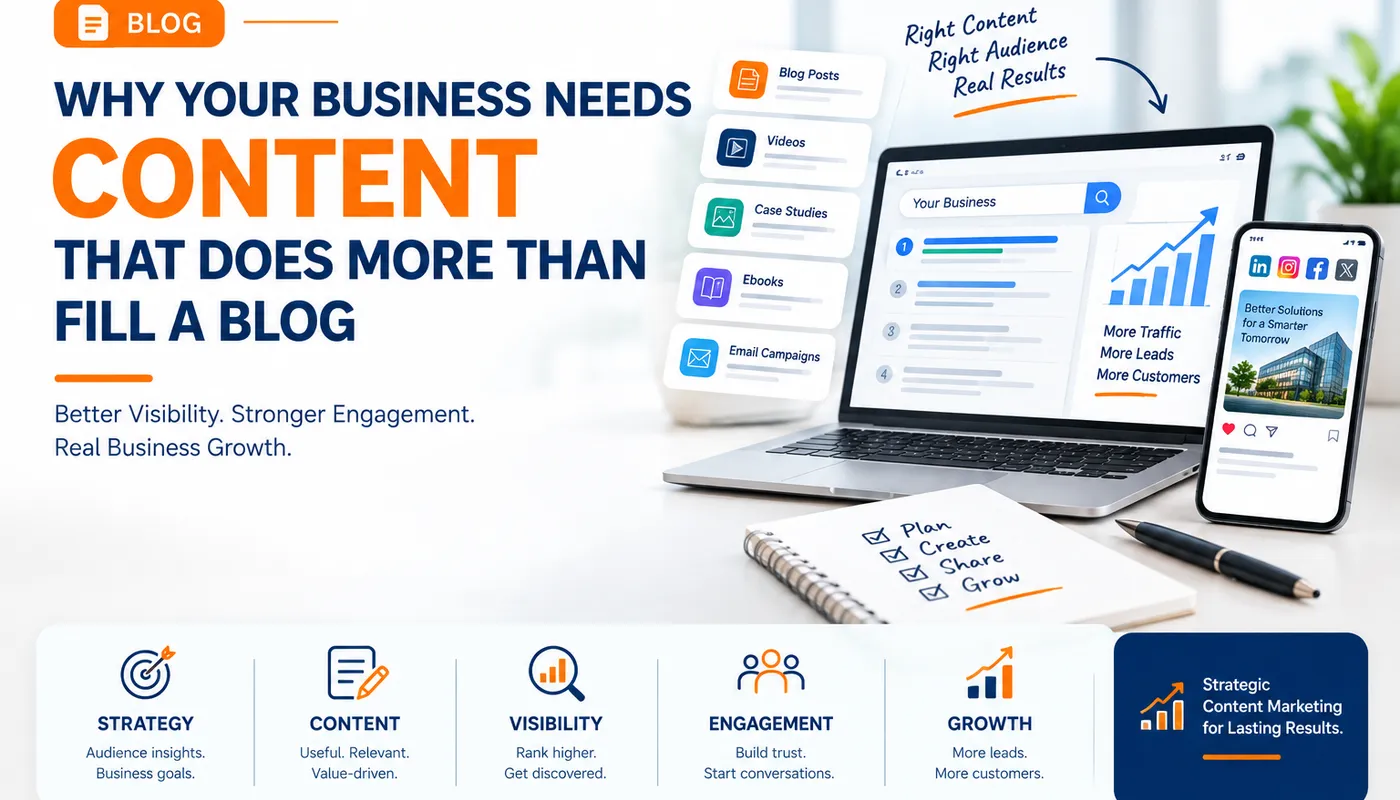
Why Your Business Needs Content That Does More Than Fill a Blog
Publishing a blog every week does not automatically create business growth.
Your audience is not looking for more words on the internet. They are looking for answers, solutions, expertise and reasons to trust a business before making a decision.
That is why modern content marketing India strategies need to focus on much more than content volume.
The right content can help a potential customer discover your business through search, understand your expertise, compare solutions and eventually take action.
A useful blog post may bring organic search traffic. A detailed case study may help a prospect evaluate your capabilities. A landing page may convert an interested visitor into a lead. A thought leadership article may establish your brand as an authority in its industry.
Each piece has a purpose.
The challenge is connecting those individual pieces into a consistent content strategy that supports the entire customer journey.
For businesses in India, this becomes particularly important in competitive markets where customers can compare multiple providers before contacting one.
PrimeSource approaches content marketing with a focus on creating content that supports visibility, customer education, brand authority and measurable business outcomes—not simply filling a publishing calendar.
What Is Content Marketing and How Does It Drive Business Growth?
Content marketing is the strategic creation, optimisation, distribution and promotion of useful content to attract and engage a defined audience.
Unlike advertising that focuses primarily on immediate promotion, content marketing can continue attracting people long after a piece of content is published.
A strong content marketing programme can include:
- Blog writing services
- SEO content writing
- Website copywriting
- Landing page content
- Case studies
- Whitepapers
- Ebooks
- Industry reports
- Thought leadership content
- Social media content
- Email content
- Educational resources
- Product and service content
The purpose is not simply to publish.
It is to help customers move through the buying journey.
For example:
Awareness:
A potential customer discovers an educational article through Google.
Consideration:
They read a comparison guide or industry analysis.
Decision:
They review a case study, service page or product page.
Conversion:
They request a consultation, submit an enquiry or make a purchase.
This makes content an important component of inbound lead generation.
When content is aligned with customer needs and business objectives, it can support organic visibility, customer trust and long-term customer acquisition.
Why a Strategic Content Marketing Approach Matters
One of the most common content marketing problems is publishing without a strategy.
A company may publish several blogs every month but still struggle to generate meaningful traffic or leads.
Why?
Because the content may not target the right audience, keyword, search intent or stage of the buyer journey.
A strategic approach starts by answering important questions:
- Who are we trying to reach?
- What problems do they have?
- What are they searching for?
- What questions do they ask before buying?
- Which topics are important to our industry?
- Which keywords can attract relevant traffic?
- What differentiates our business?
- What action should the reader take?
- Which content formats best support the buying journey?
Content Planning
A proper content plan can identify:
- Core topics
- Supporting topics
- Target keywords
- Search intent
- Content formats
- Publishing frequency
- Distribution channels
- Conversion opportunities
Content Gap Analysis
A content gap analysis can identify subjects that competitors cover but your website does not.
It can also reveal opportunities to improve existing content instead of constantly creating new pages.
Competitor Content Analysis
Competitor content analysis can help identify:
- High-value topics
- Content formats
- Keyword opportunities
- Missing information
- Weak content areas
- Potential differentiation
The objective is to build a content ecosystem that supports the business—not simply a collection of disconnected articles.
Our Content Marketing Services for Businesses in India
Different businesses need different types of content.
A technology company may need detailed educational resources and thought leadership. A D2C brand may need product-focused content and storytelling. A B2B company may benefit from case studies, industry reports and decision-stage content.
Professional content marketing services can include several interconnected activities.
Content Strategy
We develop a structured business content strategy based on your audience, goals, industry and customer journey.
Content Creation
Content development can include blogs, landing pages, website content, guides, case studies and other formats.
SEO Content Writing
Content can be planned around keyword research, search intent, semantic relevance and topical authority.
Existing Content Optimisation
Older pages can often provide significant opportunities.
Content refresh activities may involve:
- Updating outdated information
- Improving headings
- Strengthening search intent alignment
- Adding relevant keywords
- Improving internal links
- Expanding missing sections
- Improving readability
- Updating metadata
Thought Leadership Content
For companies with strong subject-matter expertise, thought leadership content can turn internal knowledge into valuable external content.
Content Distribution
Creating content is only one part of the process.
Relevant content can also be distributed through:
- Search engines
- Social media
- Email marketing
- Industry communities
- Company newsletters
- Sales enablement channels
The right combination depends on where your audience spends time and how they research purchasing decisions.
How SEO Content Marketing Helps Your Customers Find You
Great content has limited value if your target audience cannot discover it.
This is why SEO content marketing connects content creation with search engine visibility.
The process starts with keyword research.
Instead of guessing what customers want, SEO content teams can identify the topics, questions and phrases people use when searching.
These may include:
- High-intent keywords
- Long-tail keywords
- Industry terminology
- Location-based searches
- Product-related searches
- Problem-based queries
- Comparison searches
- Informational questions
Search intent is equally important.
A page targeting an informational query should educate the reader. A commercial page should help the visitor evaluate a solution. A transactional page should make the next action clear.
SEO Content Optimisation
Optimisation can include:
- Keyword placement
- Meta title optimisation
- Meta description optimisation
- Header structure
- Internal linking
- Semantic keywords
- NLP-related terminology
- Search intent alignment
- Content depth
- Image optimisation
- URL optimisation
The objective is not keyword stuffing.
It is to create content that is useful to the reader while making the subject clear to search engines.
Over time, a consistent SEO content strategy can contribute to:
- Organic search traffic
- Google rankings
- Search visibility
- Website traffic growth
- Brand discovery
- Qualified leads
B2B Content Marketing: Turning Expertise Into Business Opportunities
B2B buyers rarely make important decisions after reading one page.
They may research for weeks or months.
They compare providers, investigate expertise, review case studies, read industry opinions and speak with internal stakeholders.
This makes B2B content marketing particularly valuable.
For a technology or professional services company, useful B2B content could include:
- Industry guides
- Technical explainers
- Case studies
- Whitepapers
- Research reports
- Expert articles
- Comparison content
- Implementation guides
- Buyer guides
- Frequently asked questions
Supporting the B2B Buyer Journey
Awareness-stage content can address problems and industry challenges.
Consideration-stage content can explain approaches, compare solutions and demonstrate expertise.
Decision-stage content can provide evidence through case studies, service pages, testimonials and detailed solution information.
This creates a content funnel that supports both marketing and sales.
For companies looking for content marketing strategy services for B2B India, the key is to turn internal expertise into useful resources that answer real buyer questions.
How Thought Leadership Content Builds Trust and Authority
Thought leadership is not simply writing complicated articles.
It is about demonstrating a genuine point of view, experience or understanding of a subject.
Businesses can build thought leadership by sharing:
- Industry insights
- Original perspectives
- Expert opinions
- Research findings
- Lessons from projects
- Market observations
- Practical frameworks
- Emerging trends
- Customer challenges and solutions
For B2B businesses, this can make the brand more memorable during long purchasing cycles.
A company that consistently explains complex subjects clearly can become a valuable information source for its target audience.
Thought leadership content creation India B2B therefore works best when content is based on real expertise rather than generic material rewritten from existing sources.
The strongest thought leadership content answers:
What do we know that our audience needs to understand?
That question can transform internal knowledge into external business value.
Content Marketing for Technology Companies, Startups and SMEs
Technology companies often operate in markets where products and services can be complex.
Customers may not immediately understand:
- What the product does
- Why it matters
- How it differs from alternatives
- What problem it solves
- How implementation works
- Whether it is worth the investment
Content can bridge this knowledge gap.
Technology Companies
Technology brands can use:
- Technical blogs
- Product explainers
- Case studies
- Whitepapers
- Industry reports
- Technical guides
- Thought leadership
Startups
Startups often need to establish credibility while building organic visibility.
Content can support:
- Brand awareness
- Customer education
- Search visibility
- Founder positioning
- Lead generation
SMEs
For SMEs, consistent content can create a stronger digital presence without depending entirely on paid advertising.
D2C and Ecommerce Brands
D2C businesses can combine:
- Product education
- Buying guides
- Comparison content
- Lifestyle content
- Customer stories
- SEO category content
- Product-led content
The content format changes, but the underlying principle remains the same:
Create content around what your customers need to know before they choose you.
How Multilingual and Regional Content Can Expand Your Reach
India's diverse language landscape creates opportunities for businesses that can communicate effectively with regional audiences.
English may be appropriate for many professional and B2B audiences, but some businesses can expand their reach through multilingual content and regional language strategies.
Depending on the target audience, businesses may consider:
- Regional language landing pages
- Localised blog content
- Regional social media content
- Local search optimisation
- Translated customer resources
- Location-specific content
However, multilingual content should not simply be translated word-for-word.
Effective regional content considers:
- Local search behaviour
- Cultural context
- Search terminology
- Customer preferences
- Regional intent
- Localised calls to action
For businesses targeting multiple Indian markets, multilingual content marketing India regional strategies can complement local SEO and broader content campaigns.
How to Create Content That Actually Converts
The title of this article is not just a marketing statement.
Content should have a job.
To create content that converts, businesses should connect content with customer needs and a clear next step.
1. Start With the Customer
Before writing, identify:
- Who is reading?
- What problem are they facing?
- What information do they need?
- What concerns might stop them from buying?
2. Match Content to Search Intent
A blog answering a basic question should not immediately push a sales message.
Similarly, a service page targeting a high-intent search should not make visitors search through multiple pages to understand what the company offers.
3. Provide Genuine Value
Useful content should explain, demonstrate, compare or solve something.
4. Build Trust
Trust can come from:
- Clear explanations
- Original insights
- Case studies
- Data
- Expert perspectives
- Transparent information
- Relevant examples
5. Include a Relevant CTA
The call to action should match the reader's stage.
For example:
Awareness:
Read the complete guide.
Consideration:
Explore our approach.
Decision:
Request a consultation.
6. Optimise the Conversion Path
The content should make it easy for interested visitors to take the next step.
This could mean:
- Contact forms
- Consultation requests
- Demo bookings
- Downloadable resources
- Product enquiries
- Quote requests
When content, SEO and conversion optimisation work together, content becomes a stronger business asset.
How to Measure Content Marketing Performance and ROI
Content marketing should be measurable.
The exact metrics depend on the campaign objectives, but businesses can monitor:
Organic Traffic
Are content pages attracting visitors from search engines?
Rankings
Are important keywords gaining visibility?
Engagement
Are users spending meaningful time with the content?
Leads
Are visitors submitting enquiries or taking other valuable actions?
Conversion Rate
What percentage of visitors complete a desired action?
Content-Assisted Conversions
Some content may not generate the final conversion but may influence a customer's decision later.
Content ROI
Businesses can compare content investment against measurable outcomes such as leads, conversions and revenue influenced by content.
Other useful metrics include:
- Search impressions
- Click-through rate
- Returning visitors
- Backlinks
- Content engagement
- Lead quality
- Organic traffic growth
- Conversion-assisted sessions
The right content marketing metrics should connect marketing activity with business objectives.
Publishing 100 articles is not necessarily better than publishing 30 high-quality pieces that consistently attract relevant prospects.
How Much Does Content Marketing Cost in India?
Content marketing pricing India 2026 can vary significantly depending on the scope and complexity of the campaign.
Factors can include:
- Number of content pieces
- Content length
- Research requirements
- Industry complexity
- SEO requirements
- Content formats
- Number of target keywords
- Number of target locations
- Content distribution
- Existing content optimisation
- Thought leadership requirements
- Reporting and analytics
A startup may need a focused blog and SEO content programme, while an enterprise may require a large-scale editorial strategy involving multiple content formats and markets.
When comparing content marketing packages, businesses should look beyond the number of articles.
Ask:
- Is keyword research included?
- Is search intent analysed?
- Is competitor content analysed?
- Is SEO optimisation included?
- Who performs the research?
- Is existing content refreshed?
- Is content distribution included?
- How is performance measured?
- Are revisions included?
- Is there a documented content calendar?
A clear content marketing quotation should explain deliverables, process and measurement.
The cheapest content is not necessarily the most affordable content if it produces little visibility, engagement or business value.
How to Choose the Right Content Marketing Agency in India
Choosing a content marketing agency India partner should be based on more than writing samples.
Look for a team that understands the relationship between content, SEO, customer journeys and business objectives.
Evaluate Their Strategy
Can they explain why specific topics and keywords should be targeted?
Review Content Quality
Look for content that is:
- Clear
- Accurate
- Useful
- Original
- Audience-focused
- Well structured
- Search-intent aligned
Check SEO Knowledge
Content should work with technical SEO, on-page optimisation, internal linking and broader search strategy.
Ask About Industry Experience
Technology, B2B, ecommerce and professional services often require different content approaches.
Understand Their Measurement Process
A professional provider should explain how content performance will be tracked.
Ask About Consistency
Content marketing is not a one-week campaign.
A good partner should be able to provide a sustainable content calendar and optimisation process.
If you are searching for an SEO content company Chennai Nungambakkam or a content marketing agency near me Bangalore, the same evaluation principles apply: assess strategy, quality, SEO capability, industry understanding and measurable outcomes rather than location alone.
Why Choose PrimeSource for Content Marketing?
Content works best when it is connected to a larger digital strategy.
PrimeSource combines content planning, SEO thinking and business-focused messaging to help companies create content with a clear purpose.
Our approach can support businesses looking for:
- SEO content marketing
- B2B content marketing
- Blog writing services
- Website copywriting
- Thought leadership content
- Content strategy
- Content optimisation
- Content gap analysis
- Content calendars
- Lead generation content
- Existing content refreshes
- Industry-focused content
Whether you are a startup building its first organic presence, an SME trying to generate more qualified leads, a technology company establishing thought leadership or an enterprise managing a large content ecosystem, the strategy should be built around your specific objectives.
PrimeSource focuses on creating content that can contribute to online visibility, customer education, authority and business growth.
The process begins by understanding your business, audience and search opportunities.
From there, content can be planned around the topics that matter most to your customers and your business.
FAQs
1. What is content marketing?
Content marketing is the strategic creation and distribution of useful content to attract, educate and engage a target audience while supporting business objectives such as brand awareness, organic visibility and lead generation.
2. Is content marketing useful for B2B businesses?
Yes. B2B buyers often conduct extensive research before making purchasing decisions. Educational content, case studies, whitepapers and thought leadership can support different stages of the B2B buyer journey.
3. How does content marketing support SEO?
SEO content marketing uses keyword research, search intent, content optimisation, internal linking and topical coverage to create content that can improve organic search visibility and attract relevant visitors.
4. How often should a business publish content?
There is no universal publishing frequency. Consistency and quality are generally more important than publishing a large volume of low-value content.
5. Can old blog content be improved?
Yes. Existing content can often be refreshed through updated information, improved search intent alignment, stronger structure, keyword optimisation, internal links and additional useful information.
6. What types of content can a content marketing agency create?
Depending on the strategy, content may include blogs, landing pages, case studies, whitepapers, ebooks, industry reports, website copy, thought leadership articles, social media content and email content.
7. Can content marketing generate leads?
Yes. When content targets relevant audiences and connects with appropriate conversion paths, it can contribute to inbound lead generation and qualified enquiries.
8. How much does content marketing cost in India?
Content marketing costs depend on factors such as content volume, research requirements, industry complexity, SEO scope, content formats, distribution and optimisation. A tailored quotation provides a more accurate estimate.
9. Is content marketing only about blogging?
No. Blogging is one part of content marketing. A complete strategy may include website content, landing pages, case studies, whitepapers, ebooks, social media, email and other formats.
10. How do I choose a content marketing agency?
Look for a provider with strong content quality, SEO knowledge, strategic planning, industry understanding, transparent deliverables and a clear approach to measuring performance.
Let's Create Content That Actually Converts
Your business does not need content simply because your competitors are publishing.
It needs content that gives potential customers a reason to discover you, trust you and take the next step.
The right content marketing India strategy can connect search visibility, customer education, brand authority and lead generation into one consistent growth engine.
Whether you need SEO content, B2B thought leadership, website copy, content for a technology company, regional content or an ongoing editorial strategy, the first step is understanding what your audience is actually looking for.
At PrimeSource, we help businesses approach content with purpose—from research and strategy to creation, optimisation and performance measurement.
Your next customer is searching for answers. Make sure your content is there to provide them.
Ready to Create Content That Actually Converts?
Talk to PrimeSource about your content marketing goals.
Whether you need a content marketing strategy, SEO-focused content, thought leadership or a complete content programme, let's identify the right opportunities for your business.
Request a content strategy consultation today and turn your content into a measurable business asset.