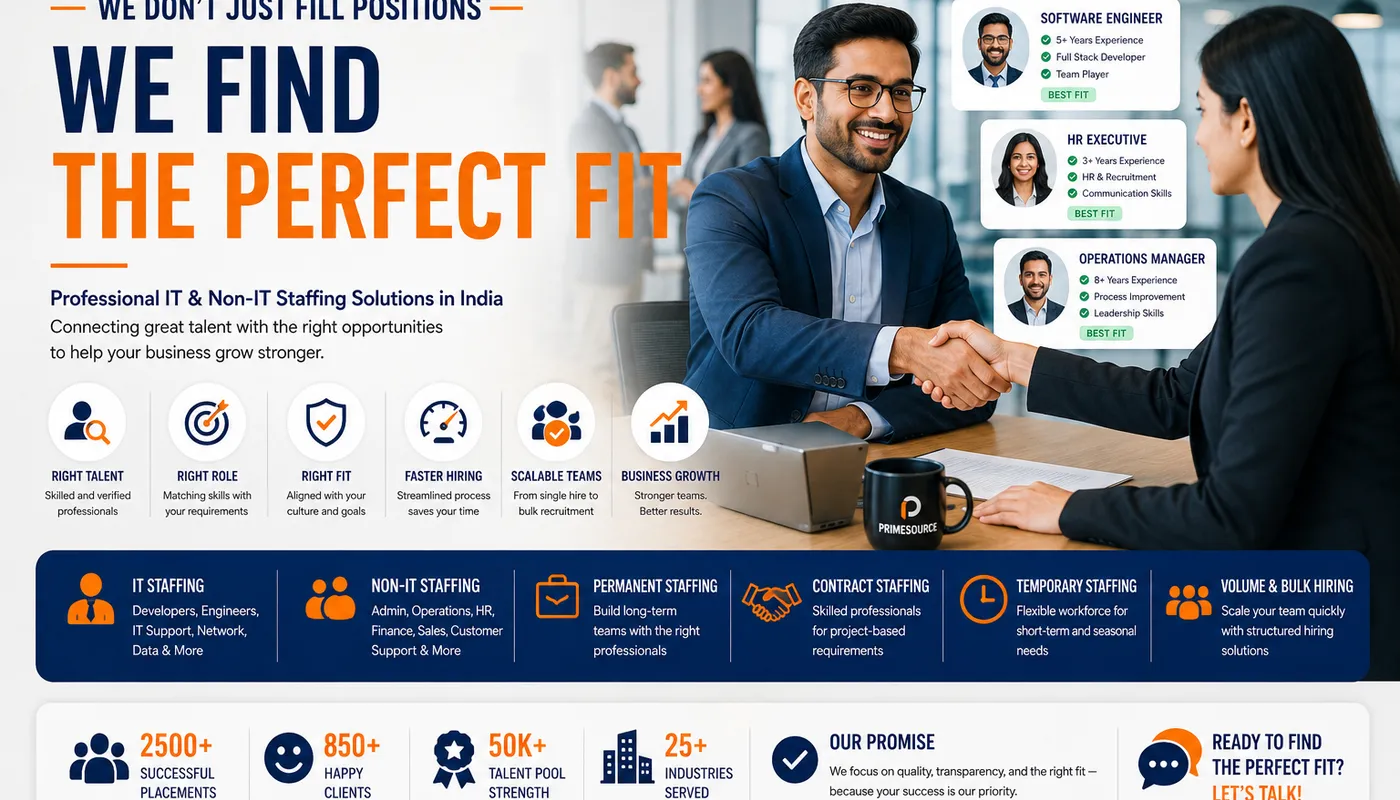
We Don't Just Fill Positions — We Find the Perfect Fit
Hiring the right person is about much more than filling an open position.
A candidate may have the required qualifications, but that does not always mean they are the right fit for the role, team, workplace culture, or long-term business goals. This is why companies increasingly look for structured IT staffing India solutions that combine talent sourcing, candidate screening, skill assessment, workforce planning, and recruitment support.
Whether a business needs software professionals, engineers, administrative staff, operations employees, customer support teams, or large-scale hiring support, the recruitment process needs to focus on quality as well as speed.
Professional staffing is ultimately about matching the right person with the right opportunity.
At PrimeSource, the approach goes beyond simply forwarding resumes. The focus is on understanding the company's requirements, identifying suitable candidates, evaluating their suitability, and helping businesses build dependable teams for long-term growth.
Featured Snippet: What Is IT & Non-IT Staffing?
IT & non-IT staffing is the process of helping businesses identify, source, screen, and hire qualified technical and non-technical professionals based on their workforce requirements.
Professional IT staffing India solutions may cover IT recruitment, engineering talent sourcing, administrative recruitment, operations staffing, permanent hiring, contract staffing, temporary staffing, lateral hiring, and volume hiring.
The objective is not simply to provide candidates. It is to find right-fit professionals who match the company's role requirements, skills, experience, and business expectations.
1. Why Finding the Right Talent Matters
A vacancy may look like a simple hiring requirement on paper, but the impact of the hiring decision can extend far beyond the recruitment process.
The wrong hire can result in:
- Delayed projects
- Lower productivity
- Increased employee turnover
- Additional recruitment costs
- Training challenges
- Team performance issues
- Operational disruptions
- Customer service problems
- Increased workload for existing employees
The right candidate, on the other hand, can contribute to productivity, collaboration, innovation, and business growth.
This is particularly important when companies are hiring for specialised technical roles or expanding their workforce rapidly.
For example, an organisation may need:
- Software developers
- QA engineers
- Network professionals
- IT support specialists
- Data professionals
- Production engineers
- Operations executives
- Administrative staff
- Sales employees
- Customer support teams
Each role requires a different recruitment approach.
That is why effective staffing should begin with understanding the business requirement, rather than immediately searching for resumes.
The Right-Fit Hiring Approach
A strong recruitment process considers several factors:
Hiring Factor
What It Evaluates
Technical skills
Whether the candidate can perform the required role
Experience
Exposure to relevant responsibilities and environments
Education
Academic background relevant to the position
Communication
Ability to collaborate and communicate effectively
Industry knowledge
Familiarity with the business environment
Role expectations
Alignment with responsibilities
Availability
Joining timeline and workforce requirements
Cultural fit
Compatibility with the organisation
Career expectations
Potential for longer-term retention
The goal is to create a stronger connection between business requirements and candidate capabilities.
2. What IT & Non-IT Staffing Actually Includes
Modern staffing is not limited to traditional recruitment.
A professional staffing partner can support different stages of the hiring lifecycle, from workforce planning and candidate sourcing to screening and onboarding support.
Core Staffing Services
1. Talent Sourcing
Recruitment begins with finding candidates through suitable talent pools and sourcing channels.
Depending on the role, this may include:
- IT professionals
- Engineering talent
- Operations staff
- Administrative professionals
- Sales professionals
- Customer support employees
- Skilled technical workers
- Entry-level candidates
- Experienced lateral hires
The sourcing strategy should change according to the position rather than relying on a single recruitment channel.
2. Candidate Screening
Receiving hundreds of resumes does not necessarily make hiring easier.
Candidate screening helps identify applicants who meet the essential requirements before they move further through the recruitment process.
Screening may consider:
- Qualifications
- Relevant experience
- Technical skills
- Industry exposure
- Communication abilities
- Location
- Notice period
- Salary expectations
- Role suitability
3. Candidate Matching
Candidate matching is where staffing becomes more strategic.
Instead of asking:
"Does this candidate have experience?"
the recruitment team should also ask:
"Does this candidate fit what the business actually needs?"
This distinction can make a significant difference to hiring outcomes.
4. Interview Coordination
A staffing partner can also support interview scheduling, candidate communication, feedback collection, and recruitment coordination.
This reduces administrative pressure on internal HR and talent acquisition teams.
5. Recruitment Support
Depending on the staffing model, support may continue through:
- Candidate selection
- Offer coordination
- Documentation
- Joining follow-up
- Employee onboarding
- Recruitment reporting
This creates a more organised recruitment process.
3. IT Staffing Solutions for Modern Businesses
Technology continues to influence almost every industry, increasing demand for professionals with specialised technical skills.
Professional IT staffing India services can help organisations identify candidates for a wide range of technology positions.
Common IT Staffing Requirements
Businesses may require:
- Software developers
- Frontend developers
- Backend developers
- Full-stack developers
- Mobile application developers
- QA and testing professionals
- DevOps engineers
- Cloud professionals
- Data analysts
- Data engineers
- Cybersecurity professionals
- Network administrators
- System administrators
- IT support professionals
- UI/UX professionals
- Project coordinators
- Technical support executives
The recruitment approach should be adapted to the specific technical requirements of each position.
For example, hiring a software developer requires evaluating technical capabilities, development experience, project exposure, and technology knowledge.
Hiring an IT support professional may require a different combination of technical knowledge, troubleshooting ability, communication skills, and customer-facing experience.
Why Technical Recruitment Requires Special Attention
Technical roles can be difficult to evaluate using resumes alone.
Two candidates may have similar job titles but very different practical experience.
A strong tech recruitment India process therefore considers:
- Actual technical skills
- Relevant project experience
- Technology stack
- Problem-solving capabilities
- Role-specific experience
- Industry exposure
- Communication skills
- Career progression
This helps businesses move from simple resume collection toward more meaningful talent evaluation.
4. Non-IT Staffing Solutions Across Industries
Staffing requirements are not limited to technology companies.
Manufacturing, healthcare, logistics, retail, finance, education, hospitality, professional services, and other industries require dependable non-technical professionals to maintain day-to-day operations.
Professional non-IT staffing India solutions can support organisations looking for employees across operational and administrative functions.
Common Non-IT Staffing Requirements
Depending on the business, hiring may include:
- Operations executives
- Administrative staff
- HR professionals
- Finance and accounting employees
- Sales executives
- Customer service representatives
- Office administrators
- Production staff
- Quality professionals
- Logistics employees
- Procurement staff
- Warehouse employees
- Supervisors
- Reception and front-office staff
These roles may not require software development expertise, but they are equally important to business performance.
Technical and Non-Technical Talent Under One Recruitment Strategy
For growing businesses, hiring needs can span multiple departments simultaneously.
For example, a manufacturing company expanding its operations may need:
- Production engineers
- Quality engineers
- IT support professionals
- HR executives
- Accounts staff
- Administrative employees
- Operations supervisors
Instead of managing separate recruitment processes with multiple vendors, companies can explore IT and non-IT staffing solutions for companies India through a more coordinated workforce strategy.
This can simplify vendor management and improve recruitment consistency.
5. How the Right Staffing Partner Improves Hiring
Internal HR teams often manage multiple responsibilities at the same time.
Recruitment may involve:
Requirement → Sourcing → Screening → Shortlisting → Interviews → Selection → Offer → Joining → Onboarding
When multiple positions are open simultaneously, this process can quickly become resource-intensive.
A staffing partner can provide additional recruitment capacity without requiring the organisation to expand its internal hiring team.
Benefits of Professional Staffing Support
Faster Candidate Sourcing
A staffing agency can work with existing talent pools and recruitment networks to identify candidates more efficiently.
Better Candidate Screening
Initial screening can reduce the number of unsuitable profiles reaching the hiring team.
Reduced Recruitment Workload
HR and talent acquisition teams can spend more time on strategic responsibilities while recruitment support handles sourcing and coordination.
Access to Wider Talent Pools
External staffing partners may help businesses reach candidates who are not easily accessible through their existing recruitment channels.
Support During Workforce Expansion
When companies need to hire several employees within a short period, additional recruitment capacity becomes particularly valuable.
Flexible Hiring Models
Businesses can select permanent, contract, temporary, or volume hiring models depending on their workforce requirements.
6. Permanent, Contract and Temporary Staffing
Not every business requirement needs the same type of employment arrangement.
The right staffing model depends on the organisation's operational needs, project duration, workforce strategy, and hiring objectives.
Permanent Staffing
Permanent staffing is suitable when a company wants to build long-term internal teams.
Common examples include:
- Full-time IT professionals
- Engineers
- HR employees
- Finance teams
- Operations managers
- Administrative staff
The recruitment process typically focuses heavily on long-term suitability and career alignment.
Contract Staffing
Contract staffing can be useful when organisations require professionals for specific projects or defined periods.
Examples include:
- Software implementation projects
- Digital transformation projects
- Infrastructure assignments
- Temporary operational expansion
- Specialised technical requirements
Temporary Staffing
Temporary staffing may help businesses address short-term workforce requirements.
This can be useful during:
- Seasonal demand
- Temporary employee shortages
- Short-term projects
- Business expansion periods
- Increased operational workloads
Choosing the Right Staffing Model
The right model depends on the business objective.
Requirement
Suitable Staffing Model
Long-term team building
Permanent staffing
Project-based requirement
Contract staffing
Short-term workforce requirement
Temporary staffing
Large recruitment requirement
Volume hiring
Specialist position
Technical/lateral hiring
Multiple departments
Combined staffing solutions
A good staffing partner should help businesses understand these options rather than pushing one model for every requirement.
7. How Candidate Screening Helps Find Better Fits
Finding candidates is only the first step.
The real value of recruitment comes from determining whether those candidates are suitable for the organisation.
A structured screening process can help businesses evaluate candidates against clearly defined requirements.
A Practical Candidate Screening Process
Step 1: Understand the Job Requirement
Identify the essential qualifications, skills, experience, responsibilities, and expectations.
Step 2: Source Relevant Candidates
Search for candidates who meet the basic requirements.
Step 3: Review Candidate Profiles
Evaluate resumes and professional backgrounds.
Step 4: Conduct Initial Screening
Assess relevant experience, communication, availability, salary expectations, and role interest.
Step 5: Evaluate Role Suitability
Compare candidate capabilities with the actual requirements of the position.
Step 6: Shortlist Candidates
Present only relevant profiles to the hiring team.
Step 7: Coordinate Interviews
Support the next stage of the recruitment process.
Step 8: Collect Feedback
Use hiring manager feedback to refine the candidate search where necessary.
This creates a continuous recruitment loop rather than treating hiring as a one-time transaction.
Expert Tip: Define the Candidate Before Searching for the Candidate
One of the most common recruitment mistakes is starting the candidate search before clearly defining the role.
Before sourcing begins, businesses should establish:
- Required skills
- Minimum experience
- Preferred experience
- Educational qualifications
- Job responsibilities
- Location
- Work arrangement
- Joining timeline
- Salary range
- Technical requirements
- Soft-skill expectations
The clearer the requirement, the easier it becomes to identify a right-fit candidate.
A Better Staffing Mindset
The traditional approach to recruitment often looks like:
Vacancy → Resume → Interview → Hire
A more effective staffing approach looks like:
Business Requirement → Workforce Planning → Talent Sourcing → Screening → Candidate Matching → Interview → Selection → Onboarding
The second approach focuses on the quality of the match.
That is the difference between filling a position and building a workforce.
What Businesses Should Expect From a Staffing Partner
A professional recruitment partner should provide more than a database of resumes.
Businesses should look for:
- Clear understanding of job requirements
- Strong talent sourcing capabilities
- Technical and non-technical recruitment expertise
- Structured candidate screening
- Transparent communication
- Timely candidate updates
- Flexible staffing models
- Support for volume hiring
- Recruitment coordination
- Long-term partnership mindset
The ultimate goal should be simple:
The right candidate. The right role. The right business fit.
We Don't Just Fill Positions — We Find the Perfect Fit
8. When Businesses Need Volume and Bulk Hiring
Hiring one employee and hiring fifty employees are very different recruitment challenges.
When a company needs to recruit multiple employees within a short period, internal HR teams may face difficulties managing candidate sourcing, screening, interview coordination, follow-ups, and onboarding simultaneously.
This is where volume hiring and bulk hiring support can become valuable.
Businesses may require large-scale recruitment when they are:
- Opening a new branch
- Expanding operations
- Launching a new project
- Scaling an IT team
- Setting up a new department
- Increasing manufacturing capacity
- Entering a new market
- Preparing for seasonal demand
- Replacing a large number of employees
- Building teams across multiple locations
How Volume Hiring Works
A structured bulk recruitment process may look like:
Workforce Requirement → Job Profiles → Candidate Sourcing → Initial Screening → Shortlisting → Interviews → Selection → Offer Coordination → Onboarding
The process needs to be organised carefully because speed should not come at the expense of candidate quality.
A staffing partner can help businesses manage multiple recruitment requirements simultaneously while maintaining defined screening criteria.
Bulk Hiring vs Individual Hiring
Individual Hiring
Volume Hiring
One or a few vacancies
Multiple vacancies
Highly targeted sourcing
Multiple sourcing channels
Individual candidate evaluation
Structured screening process
Smaller candidate pipeline
Larger talent pool
Flexible recruitment timeline
Faster hiring cycles
Limited coordination
High-volume coordination
For companies planning workforce expansion, volume hiring IT non-IT India solutions can provide additional recruitment capacity without putting excessive pressure on internal teams.
9. IT & Non-IT Staffing for Different Industries
Every industry has different workforce requirements.
A technology company may prioritise software developers and IT professionals, while a manufacturing organisation may need engineers, production staff, quality professionals, and administrative employees.
A flexible staffing partner should understand these differences.
IT & Technology Companies
Technology companies may require:
- Software developers
- Full-stack developers
- QA engineers
- DevOps professionals
- Cloud specialists
- IT support staff
- Project managers
- Technical consultants
Professional tech recruitment India can help organisations identify candidates with the technical capabilities required for specialised roles.
Manufacturing Companies
Manufacturing businesses may require:
- Production engineers
- Quality engineers
- Maintenance professionals
- Operations staff
- Supervisors
- Procurement employees
- Warehouse personnel
- Administrative teams
Combining engineering and operational recruitment can be particularly useful when a manufacturing company is expanding.
Startups and SMEs
Startups often need to build teams quickly while managing budgets carefully.
They may require a combination of:
- Developers
- Sales executives
- Marketing professionals
- Customer support
- Operations employees
- Administrative staff
A flexible staffing strategy can help startups scale their workforce according to business growth.
Enterprises
Large organisations may manage recruitment across several departments and locations.
Their requirements can include:
- IT manpower
- Administrative staff
- Finance teams
- HR professionals
- Operations employees
- Customer support teams
- Engineering talent
- Project-based professionals
For such organisations, scalable workforce solutions and structured recruitment processes become increasingly important.
10. Lateral Hiring and Specialised Talent Sourcing
Not every position can be filled through entry-level recruitment.
Some businesses need experienced professionals who can take responsibility quickly and contribute with limited training.
This is where lateral hiring becomes important.
Lateral hiring focuses on recruiting professionals with relevant experience for a specific role rather than hiring candidates primarily based on future potential.
When Lateral Hiring Makes Sense
Businesses may consider lateral hiring when they need:
- Experienced technical professionals
- Team leaders
- Project managers
- Engineering specialists
- Senior operations staff
- Department-level professionals
- Candidates with specialised industry knowledge
Benefits of Lateral Hiring
Experienced professionals may bring:
- Existing technical knowledge
- Industry experience
- Problem-solving capabilities
- Professional networks
- Faster role adaptation
- Experience managing responsibilities
- Understanding of business processes
However, experience alone should not determine selection.
The candidate still needs to match the organisation's role expectations, working environment, compensation structure, and long-term objectives.
That is why effective technical and non-technical talent sourcing India should combine experience assessment with role-fit evaluation.
11. Local Staffing Considerations Across India
India's talent market is diverse, and workforce requirements can vary significantly between cities and regions.
Companies may search for staffing support using location-specific terms such as:
- IT staffing agency Bengaluru Koramangala
- non-IT recruitment firm Chennai Guindy
- IT manpower company Hyderabad Kondapur
- tech and admin staffing Noida Sector 62
- IT staffing near me Bangalore
- non-IT recruitment near me Mumbai
- IT manpower near me Hyderabad
- tech staffing near me Noida NCR
However, businesses should not choose a staffing partner solely because the agency appears for a particular location-based search.
What to Consider With Local Recruitment
A staffing partner should understand:
- Local talent availability
- Industry-specific hiring patterns
- Candidate expectations
- Relevant salary ranges
- Joining timelines
- Local business requirements
- Commuting and location considerations
- Regional recruitment challenges
For businesses hiring across multiple cities, the ability to manage recruitment consistently across locations can be particularly valuable.
Example
A growing company may need:
Bengaluru: Software developers
Chennai: Operations and engineering staff
Hyderabad: IT professionals
Noida NCR: Technical and administrative employees
Rather than treating every location as an isolated hiring project, businesses can build a coordinated workforce strategy.
12. Common Recruitment Challenges Businesses Face
Even experienced HR teams can encounter difficulties when hiring at scale or for specialised roles.
1. Too Many Irrelevant Resumes
Receiving a large number of resumes is not useful if most candidates do not meet the essential requirements.
Solution: Establish clear screening criteria before sourcing begins.
2. Difficulty Finding Specialised Talent
Some technical and experienced roles have smaller candidate pools.
Solution: Use targeted sourcing strategies and specialised talent networks.
3. Slow Hiring Cycles
Long recruitment processes can cause strong candidates to accept other opportunities.
Solution: Create clear recruitment stages and maintain timely communication.
4. High Candidate Drop-Off
Candidates may withdraw during interviews, offer discussions, or before joining.
Solution: Maintain regular communication and clarify role expectations early.
5. Poor Candidate-Role Matching
A candidate may satisfy basic qualifications but still not be suitable for the actual working environment.
Solution: Evaluate skills, experience, expectations, and role alignment together.
6. Hiring in Large Numbers
Internal recruitment teams may struggle to maintain quality while processing high volumes of candidates.
Solution: Use structured volume hiring and recruitment support.
7. Recruitment Workload
Sourcing, screening, scheduling, follow-ups, and reporting can consume significant HR resources.
Solution: Partner with a staffing agency that can provide additional recruitment capacity.
13. How to Choose the Right IT Staffing Agency in India
Choosing a staffing partner is an important business decision.
The lowest recruitment cost does not necessarily result in the best hiring outcome.
Instead, companies should evaluate the staffing agency based on the quality and relevance of its recruitment process.
1. Check Relevant Recruitment Experience
Look for experience in the types of roles your organisation needs.
For example, an agency specialising in general administrative hiring may not be the best fit for highly specialised technical recruitment.
2. Evaluate Candidate Sourcing Capabilities
Ask how the staffing partner identifies candidates.
A strong talent sourcing strategy may involve multiple channels and talent pools.
3. Understand the Screening Process
Ask how candidates are evaluated before they reach your hiring team.
A structured screening process can reduce unnecessary interviews.
4. Look for IT and Non-IT Capability
If your company has both technical and operational hiring requirements, a combined staffing partner can simplify recruitment management.
This is particularly useful for businesses looking for combined IT and operations staffing India solutions.
5. Assess Communication
Recruitment requires continuous coordination.
The staffing partner should provide:
- Candidate updates
- Interview coordination
- Clear communication
- Requirement clarification
- Recruitment progress
- Feedback management
6. Consider Scalability
Your staffing needs may change over time.
A good recruitment partner should be able to support:
- Single-position hiring
- Multiple vacancies
- Bulk hiring
- Permanent staffing
- Contract staffing
- Temporary staffing
- Lateral hiring
7. Understand the Commercial Terms
Before starting a recruitment partnership, clarify:
- Staffing fees
- Payment terms
- Replacement policies
- Recruitment timelines
- Scope of services
- Candidate ownership
- Reporting requirements
A clear IT staffing agency quote India should make these expectations easy to understand.
14. What Makes Right-Fit Staffing Different?
The phrase "perfect fit" does not mean finding a candidate who is perfect in every possible way.
It means finding someone whose capabilities and expectations align strongly with the actual requirements of the role and organisation.
A right-fit candidate generally aligns with several dimensions:
Skills + Experience + Role Requirements + Expectations + Work Environment + Business Goals
This approach can help businesses reduce the risk of making hiring decisions based solely on resumes or job titles.
Right-Fit Recruitment Framework
Stage
Key Question
Requirement
What does the business actually need?
Sourcing
Where can relevant talent be found?
Screening
Does the candidate meet essential criteria?
Evaluation
Can the candidate perform the required responsibilities?
Matching
Is the role suitable for the candidate?
Interview
Does the candidate meet the hiring team's expectations?
Selection
Is this a strong business and role fit?
Onboarding
Can the candidate transition successfully?
The more structured the process, the easier it becomes to make informed hiring decisions.
15. Why PrimeSource Focuses on Right-Fit Recruitment
At PrimeSource, staffing is approached as a workforce solution rather than simply a resume-sourcing activity.
The focus is on understanding what the business needs before beginning the candidate search.
PrimeSource can support businesses with IT and non-IT staffing solutions for companies India, including technical recruitment, non-technical recruitment, permanent staffing, contract staffing, volume hiring, lateral hiring, and workforce expansion requirements.
The approach focuses on:
- Understanding business requirements
- Defining role expectations
- Identifying relevant talent
- Candidate sourcing
- Initial screening
- Candidate matching
- Recruitment coordination
- Hiring support
- Workforce scalability
For businesses that need both technical and non-technical professionals, a combined recruitment approach can also simplify workforce planning.
Why Businesses Work With a Staffing Partner
The right staffing relationship can provide:
Recruitment Expertise
Access to structured sourcing and screening processes.
Flexible Workforce Support
Support for permanent, contract, temporary, and volume hiring.
Reduced HR Workload
Additional recruitment capacity when internal teams are managing multiple priorities.
Better Candidate Matching
Greater focus on role requirements and candidate suitability.
Scalable Recruitment
The ability to increase or decrease hiring support according to business requirements.
The goal is not to send the highest possible number of resumes.
The goal is to send relevant candidates who have a meaningful chance of succeeding in the role.
16. FAQs About IT & Non-IT Staffing
What is IT staffing in India?
IT staffing in India is the process of sourcing, screening, and helping businesses hire qualified technology professionals for specific workforce requirements. It can include permanent, contract, temporary, specialised, and volume hiring.
What is non-IT staffing?
Non-IT staffing focuses on recruiting professionals for roles outside traditional technology functions, such as administration, operations, sales, finance, customer support, manufacturing, logistics, and other business functions.
Can one staffing company handle both IT and non-IT recruitment?
Yes. Businesses can work with staffing providers that offer combined technical and non-technical recruitment support. This can be useful for companies hiring across multiple departments.
What is volume hiring?
Volume hiring is the recruitment of multiple employees within a defined period. It is commonly used during business expansion, new project launches, branch openings, seasonal demand, and workforce scaling.
What is lateral hiring?
Lateral hiring involves recruiting experienced professionals who already possess relevant skills and industry or functional experience for a specific role.
How does staffing reduce HR workload?
A staffing partner can support candidate sourcing, initial screening, shortlisting, interview coordination, communication, and recruitment follow-ups, allowing internal HR teams to focus on strategic workforce activities.
Can staffing agencies help with contract hiring?
Yes. Contract staffing can help businesses recruit professionals for project-based or defined-duration requirements, depending on the staffing model and applicable employment arrangements.
How do I choose the right IT staffing company in India?
Evaluate the provider's recruitment experience, talent sourcing capabilities, screening process, technical expertise, communication, scalability, service scope, commercial terms, and ability to understand your specific workforce requirements.
Is IT staffing suitable for small businesses?
Yes. Startups and SMEs can use staffing support when they need specialised professionals, faster hiring, temporary recruitment capacity, or workforce expansion without building a large internal recruitment function.
How can I request an IT staffing consultation?
Businesses can contact a staffing provider with details such as job roles, number of positions, required experience, location, employment type, joining timeline, and skill requirements. This allows the staffing team to understand the requirement and recommend a suitable recruitment approach.
17. Conclusion
The right employee can influence productivity, team performance, customer experience, and long-term business growth.
That is why effective staffing should be about more than filling vacancies.
Professional IT staffing India solutions combine workforce planning, talent sourcing, candidate screening, role matching, recruitment coordination, and hiring support to help businesses build stronger teams.
At the same time, organisations need reliable non-IT staffing India solutions for operations, administration, engineering, sales, customer service, manufacturing, logistics, and other essential functions.
Whether a business needs one specialised professional, a complete IT team, non-technical employees, contract resources, or large-scale recruitment support, the process should always begin with understanding the actual workforce requirement.
The objective is simple: find the right person for the right role at the right time.
That is what turns recruitment from a transaction into a genuine recruitment partnership.
18. We Don't Just Fill Positions — We Find the Perfect Fit
Your next great hire could be the person who helps your business solve a technical challenge, strengthen operations, manage growth, or build a completely new team.
The challenge is finding that person efficiently.
Whether you are looking to hire IT non-IT staff India affordable bulk, recruit experienced professionals, expand your technical workforce, or outsource part of your recruitment process, the right staffing partner can make the journey more structured and manageable.
PrimeSource helps businesses explore practical workforce solutions based on their hiring requirements, industry, location, role complexity, and recruitment volume.
Ready to Find the Right Talent?
Need IT professionals?
Explore technical recruitment and IT manpower solutions.
Need non-IT employees?
Find suitable talent for operations, administration, engineering, sales, and other business functions.
Planning bulk hiring?
Build a structured recruitment pipeline for multiple positions.
Looking for experienced professionals?
Explore lateral hiring and specialised talent sourcing.
Need a recruitment partner?
Discuss your workforce requirements with PrimeSource.
Start Your Recruitment Conversation
We Don't Just Fill Positions — We Find the Perfect Fit.
Contact PrimeSource today to discuss your staffing requirements and build a stronger workforce.