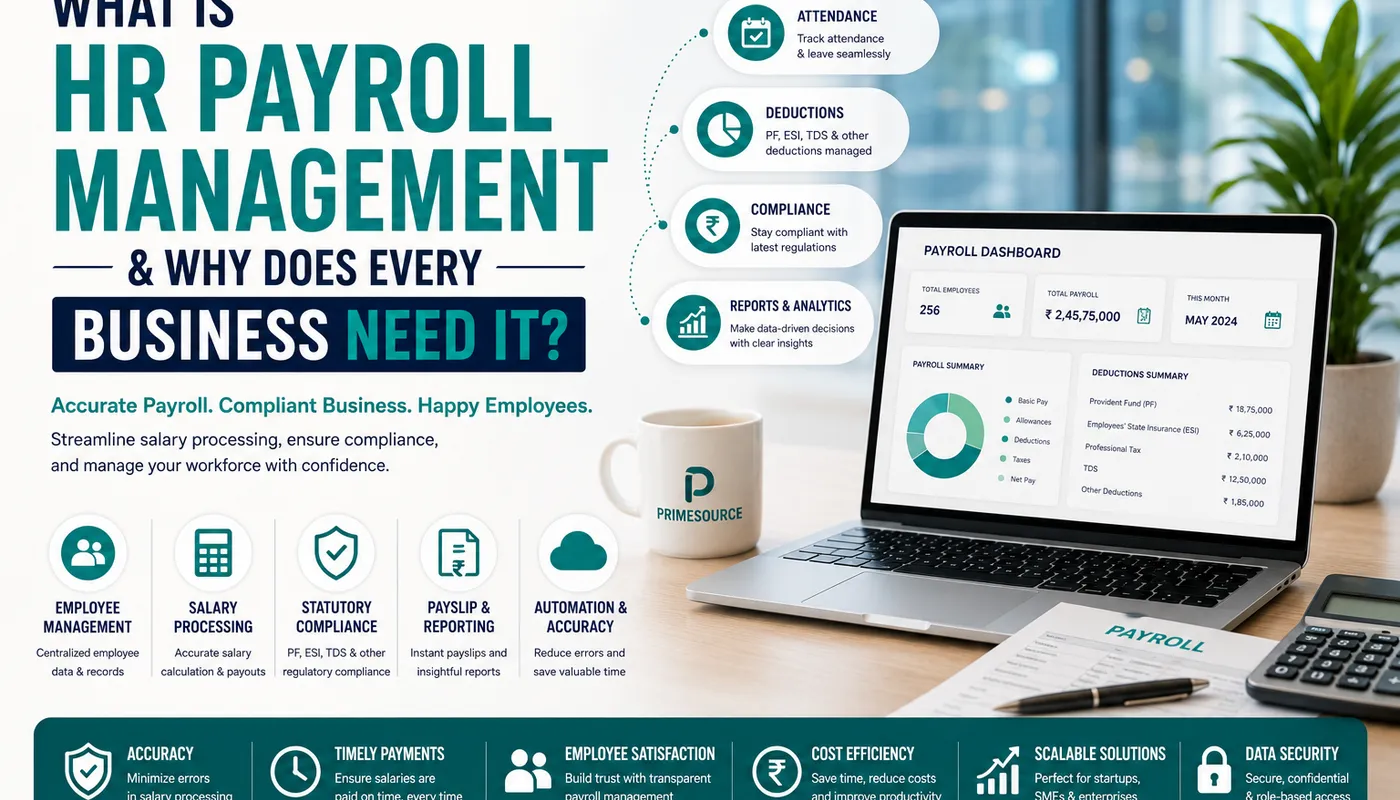
What is HR Payroll Management & Why Does Every Business Need It?
Managing employees is not only about hiring the right people and maintaining a productive workplace. Businesses must also ensure that employees receive the correct salary on time, deductions are calculated properly, payroll records are maintained, and statutory requirements are followed.
This is where HR payroll management becomes important.
For businesses in India, payroll involves much more than calculating monthly salaries. It can include attendance and leave data, salary calculations, deductions, tax-related requirements, PF and ESI compliance, payslip generation, payroll reporting, employee records, and payroll reconciliation.
As a workforce grows, managing these activities manually can become time-consuming and increase the possibility of errors. A structured payroll management India process helps businesses improve payroll accuracy, maintain better records, reduce administrative workload, and create a more reliable salary-processing cycle.
Businesses can manage payroll internally using payroll software and dedicated employees, or they can work with a professional payroll service provider. Outsourcing can be particularly useful for SMEs and companies that do not want their HR and finance teams spending excessive time on repetitive payroll administration.
PrimeSource helps businesses approach payroll as an important part of workforce management rather than simply a monthly salary calculation task.
What is HR Payroll Management?
HR payroll management is the process of managing employee salary calculation, payroll processing, deductions, records, payslips, compliance requirements, and payroll-related reporting within an organisation.
A typical payroll cycle begins with collecting employee information, attendance, leave, salary structures, incentives, deductions, and other relevant inputs. These details are then processed to determine the employee's payable salary.
Depending on the organisation, the payroll management process may include:
- Employee salary processing
- Attendance and leave management
- Salary calculation
- Payroll deductions
- TDS calculation
- PF and ESI-related processing
- Payslip generation
- Employee payroll records
- Statutory payroll filings
- Payroll reconciliation
- Payroll reporting and analytics
- Payroll data management
- Employee benefits administration
The exact payroll requirements vary according to employee strength, salary structure, business type, location, and applicable regulations.
For this reason, effective payroll management requires a combination of accurate data, clearly defined processes, appropriate technology, and compliance awareness.
Why Payroll Management Matters to Every Business
Payroll directly affects employees and the financial operations of a business. Employees expect their salaries to be accurate and paid on schedule, while employers need reliable records and processes to manage costs and compliance.
Poor payroll administration can create problems such as:
- Incorrect salary payments
- Payroll errors
- Delayed salary processing
- Incorrect deductions
- Employee dissatisfaction
- Poor payroll records
- Increased administrative workload
- Compliance-related risks
- Difficult payroll reconciliation
- Lack of transparency
A structured payroll process helps reduce these risks.
1. Ensures Accurate Salary Processing
Salary calculation may involve basic salary, allowances, incentives, overtime, deductions, leave adjustments, taxes, and other components.
Even a small calculation error can affect an employee's monthly income.
A properly managed payroll process uses defined salary structures and verified payroll inputs to improve payroll accuracy.
2. Supports Timely Salary Payments
Payroll needs to follow a consistent monthly cycle.
When attendance information, approvals, salary calculations, deductions, and payment processing are handled efficiently, businesses can reduce unnecessary delays and ensure employees receive their salaries on time.
3. Helps Manage Payroll Compliance
Businesses operating in India may have several payroll-related statutory responsibilities depending on their workforce and applicable rules.
Payroll administration may involve areas such as:
- Provident Fund (PF)
- Employees' State Insurance (ESI)
- Tax Deducted at Source (TDS)
- Applicable statutory deductions
- Payroll-related records and filings
A structured PF ESI TDS payroll compliance India process can help businesses maintain better control over these activities.
Compliance requirements can change, so businesses should ensure that payroll processes are reviewed against the latest applicable rules and professional guidance.
4. Improves Employee Trust
Employees generally want clear information about how their salary has been calculated.
Accurate payslips, transparent deductions, timely salary payments, and accessible payroll records can create greater confidence in the employer's payroll process.
Payroll therefore has an impact beyond finance. It can influence the employee experience as well.
What Does the Payroll Management Process Include?
A professional payroll management process generally follows a structured cycle.
Step 1: Collect Employee Information
The payroll team maintains relevant employee information such as:
- Employee details
- Joining date
- Designation
- Salary structure
- Bank details
- Tax-related information
- PF/ESI-related information where applicable
- Benefits and allowances
Accurate employee records are essential because payroll calculations depend on this information.
Step 2: Collect Attendance and Leave Data
Attendance and leave information may affect salary calculations.
For example, payroll processing may need to account for:
- Working days
- Leave taken
- Loss of pay
- Overtime
- Shift allowances
- Attendance adjustments
This is why payroll and attendance management India solutions are often connected.
Step 3: Calculate Gross Salary
The payroll process calculates the employee's gross earnings according to the organisation's salary structure.
This may include components such as:
- Basic salary
- House rent allowance
- Other allowances
- Incentives
- Overtime
- Bonuses or applicable variable components
The components differ between organisations and employment structures.
Step 4: Calculate Applicable Deductions
After determining earnings, applicable deductions are considered.
These may include:
- Employee PF contribution where applicable
- ESI contribution where applicable
- TDS
- Professional tax where applicable
- Leave or attendance-related deductions
- Other authorised deductions
The resulting amount determines the employee's net salary.
Step 5: Generate Payslips
Payslips provide employees with a record of their salary calculation.
A payslip can typically show:
- Earnings
- Deductions
- Gross salary
- Net salary
- Applicable contribution details
- Other payroll information
Digital payslip generation can make payroll administration more efficient and improve employee access to salary information.
Step 6: Payroll Reconciliation and Reporting
Before finalising payroll, businesses should review payroll data for inconsistencies and reconcile relevant figures.
Payroll reporting can help HR and finance teams understand:
- Total salary costs
- Department-wise payroll
- Employee deductions
- Attendance-related adjustments
- Payroll variances
- Workforce costs
This creates better visibility for payroll cost management and workforce planning.
HR Payroll Management vs Manual Payroll Processing
Small organisations sometimes manage payroll using spreadsheets and manual calculations. While this may work for a very small workforce, complexity increases as the company grows.
Manual Payroll
Structured Payroll Management
Spreadsheet-based calculations
Defined payroll processing system
Higher dependency on manual entry
Greater process automation
More repetitive work
Automated calculations where appropriate
Difficult to manage growing employee data
Better employee record management
Greater risk of calculation errors
Improved payroll accuracy
Manual payslip preparation
Automated payslip generation
Limited reporting
Better payroll reporting
Higher administrative workload
More efficient payroll administration
Manual processing is not automatically unsuitable. The right approach depends on workforce size, payroll complexity, available resources, and business requirements.
However, as organisations grow, a structured payroll process becomes increasingly valuable.
Why Businesses Are Moving Towards Payroll Automation
Payroll automation uses technology to reduce repetitive manual activities within the payroll cycle.
An automated payroll processing company India SMEs can help businesses streamline activities such as salary calculations, employee records, payslip generation, payroll reports, and selected workflow processes.
A modern payroll system may provide:
- Automated salary calculations
- Digital employee records
- Automated payslip generation
- Attendance integration
- Leave management integration
- Payroll reporting
- Employee self-service
- Data access controls
- Payroll workflow automation
Benefits of Payroll Automation
Reduced manual work: Repetitive calculations and administrative activities can be streamlined.
Better accuracy: Automated calculations can reduce certain types of manual entry and calculation errors.
Faster processing: Payroll teams can process recurring payroll activities more efficiently.
Better visibility: HR and finance teams can access organised payroll information and reports.
Employee self-service: Employees may be able to access payslips and selected payroll information without repeatedly contacting HR.
Scalability: A structured system can make it easier to manage payroll as the workforce expands.
However, automation does not eliminate the need for human review. Payroll data still needs validation, approvals, exception handling, and compliance oversight.
How Attendance and Leave Management Connect with Payroll
Payroll cannot always be separated from day-to-day employee management.
Attendance and leave data can influence salary calculations, particularly where organisations have policies involving loss of pay, overtime, shift allowances, or other attendance-linked components.
A connected HR and payroll management services India company may therefore integrate:
Employee Records → Attendance → Leave → Payroll Calculation → Deductions → Payslip → Reporting
This reduces the need to transfer information manually between separate systems.
For example, if approved attendance data is automatically available to the payroll process, the payroll team may spend less time collecting and reconciling information from different spreadsheets.
The objective is not simply automation. It is to create a more consistent flow of reliable information throughout the payroll cycle.
When Should a Business Consider Outsourcing Payroll?
Payroll outsourcing can be useful when internal teams spend significant time managing payroll administration or when payroll complexity has increased.
Businesses may consider payroll outsourcing India when:
- The employee count is growing
- Payroll takes too much HR time
- Manual calculations create frequent errors
- Compliance administration is becoming difficult
- The business is expanding across locations
- HR and finance teams need to focus on strategic activities
- Payroll requires specialised knowledge
- The company wants a more structured payroll process
- Existing payroll systems are difficult to manage
- Management wants better payroll reporting
For startups and SMEs, outsourcing can provide access to professional payroll support without requiring a large internal payroll administration team.
For larger organisations, outsourced payroll management can also complement existing HR and finance functions by handling defined parts of the payroll workflow.
Payroll Management for Growing Indian Businesses
Payroll requirements can change significantly as a company grows.
A small business may have a straightforward payroll structure with a limited number of employees. As the organisation expands, it may introduce multiple departments, locations, salary structures, benefits, incentives, attendance systems, and different employee categories.
For example:
Small Business
Employee Records → Attendance → Salary Calculation → Payslips
Growing Business
Employee Records → Attendance & Leave → Salary Structures → Deductions → Compliance → Payroll Processing → Reconciliation → Reporting
This is why businesses should think about payroll as a scalable process rather than a monthly administrative task.
Whether a company uses an internal team, payroll software, a cloud-based payroll management solution, or an external payroll partner, the system should be capable of supporting the organisation's current requirements while allowing room for future growth.
Expert Tip
Do not select a payroll solution based only on software features or price.
Before choosing payroll software or a service provider, evaluate the complete process: employee data management, attendance integration, salary calculation, statutory requirements, reporting, security, support, scalability, and the level of human assistance available.
The best payroll approach is the one that makes payroll accurate, manageable, transparent, compliant, and scalable for your organisation.
Payroll Compliance in India: Why It Matters
Payroll compliance is one of the most important responsibilities within payroll administration. Businesses must ensure that applicable deductions, contributions, records, and filings are handled correctly according to the requirements relevant to their organisation and employees.
For companies searching for statutory compliance payroll services India company, the objective should not be limited to completing monthly salary processing. A reliable payroll process should also include proper documentation, review, reporting, and compliance monitoring.
Depending on the organisation and applicable rules, payroll-related compliance may involve areas such as:
- Provident Fund (PF)
- Employees' State Insurance (ESI)
- TDS
- Professional tax where applicable
- Salary-related statutory records
- Applicable returns and filings
- Employee documentation
Because statutory requirements can change, businesses should verify current rules and filing requirements with appropriate professional or government sources.
Common Payroll Compliance Challenges
Businesses may face challenges when:
- Employee data is incomplete or outdated
- Payroll calculations are performed manually
- Attendance data is not properly integrated
- Deductions are calculated incorrectly
- Filing deadlines are missed
- Payroll records are poorly maintained
- Compliance responsibilities are unclear
A structured payroll process can help HR and finance teams establish clearer responsibilities and review procedures.
What Are Outsourced Payroll Management Services?
Outsourced payroll management services for companies India involve assigning some or all payroll-related activities to an external payroll service provider.
Instead of managing every payroll activity internally, a company can work with a payroll partner for functions such as:
- Employee payroll data management
- Salary processing
- Payroll calculations
- Payslip generation
- Attendance and leave integration
- Payroll reporting
- Payroll reconciliation
- Applicable statutory support
- Payroll administration
The exact scope depends on the agreement between the business and service provider.
How Payroll Outsourcing Works
A typical outsourced payroll workflow can look like this:
Business Provides Data → Payroll Partner Validates Inputs → Payroll Processing → Review & Approval → Payslips → Reports → Compliance Support
This approach allows the internal HR or finance team to remain involved in approvals and decision-making while reducing the amount of repetitive payroll administration they need to perform themselves.
Benefits of Payroll Outsourcing for Businesses
Payroll outsourcing can provide several practical benefits when implemented properly.
Reduces HR and Administrative Workload
Payroll involves recurring activities every month. Outsourcing selected responsibilities allows internal HR teams to spend more time on recruitment, employee engagement, performance management, workforce planning, and other strategic priorities.
Provides Access to Payroll Expertise
A specialised payroll partner works with payroll processes regularly and can bring structured workflows and operational experience to the engagement.
Supports Growing Workforces
As employee numbers increase, payroll administration becomes more complex.
A professional payroll service can provide scalable support for businesses moving from a small workforce to a larger organisation.
Improves Process Consistency
Defined workflows can reduce unnecessary variation between payroll cycles.
A consistent process can make salary processing, approvals, reconciliation, reporting, and record management easier to manage.
Can Improve Cost Efficiency
Businesses should consider the total cost of payroll—not only software fees, but also employee time, administration, error correction, system maintenance, compliance work, and reporting.
For some companies, outsourcing can provide a more predictable and efficient approach.
Cloud-Based Payroll Management Solutions
A cloud-based payroll management solution India can provide businesses with access to payroll information through an online system rather than relying entirely on locally stored spreadsheets or files.
Cloud payroll systems may offer features such as:
- Employee information management
- Salary processing
- Digital payslips
- Attendance integration
- Leave management
- Payroll reports
- Employee self-service
- Role-based access
- Payroll data storage
- Workflow approvals
Why Cloud Payroll Can Be Useful
Accessibility: Authorised users can access payroll information from supported locations.
Centralised information: Employee and payroll data can be managed within a structured system.
Scalability: Cloud systems can be easier to expand as employee numbers increase.
Automation: Repetitive payroll activities can be streamlined.
Employee access: Employees may be able to access payslips and selected information through self-service features.
However, businesses should carefully evaluate access controls, security practices, backups, data protection, support, and integration capabilities before selecting a cloud payroll platform.
Payroll Data Security Should Be a Priority
Payroll contains sensitive business and employee information. This can include salary details, bank information, tax information, employee records, and other confidential data.
Therefore, payroll data security should be considered when choosing payroll software or a payroll service provider.
Businesses should evaluate:
- User access controls
- Role-based permissions
- Secure authentication
- Data backup practices
- Audit trails
- Data transmission security
- Employee access controls
- Vendor security practices
- Data retention procedures
Only authorised employees should have access to payroll information relevant to their responsibilities.
Security is particularly important when payroll systems are cloud-based or when payroll information is shared with an external provider.
Payroll Services for Different Types of Businesses
Payroll requirements are not identical for every company.
Startups and Small Businesses
Startups may have limited HR resources and need simple, reliable payroll administration as their workforce grows.
A structured payroll system can help founders and small HR teams manage salary processing without allowing payroll activities to consume excessive administrative time.
SMEs
SMEs may benefit from SME payroll management solutions that combine salary processing, compliance support, attendance integration, reporting, and employee records.
Outsourcing can be particularly useful when an SME does not have a dedicated payroll specialist.
Enterprises
Large organisations may have multiple departments, locations, salary structures, and employee categories.
Enterprise payroll management therefore requires greater process control, integration, reporting, security, and scalability.
Companies With Distributed Teams
Businesses operating across multiple cities may need a centralised payroll process that supports consistent administration while accounting for relevant regional requirements.
For example, businesses may search for payroll support such as:
- Payroll management company Bengaluru for IT firms
- Outsourced payroll services Chennai corporate
- Payroll processing company Hyderabad pharma IT
- Payroll services Mumbai SEEPZ Andheri MIDC
Location-specific searches can help businesses identify relevant providers, but the final selection should be based on actual capability, service scope, experience, compliance processes, and support quality.
Payroll and HR Management Should Work Together
Payroll should not operate completely separately from HR.
HR teams manage information such as employee joining dates, designations, salary changes, leave, attendance, promotions, transfers, and exits. Many of these changes can affect payroll.
This creates a natural connection:
HR Management → Employee Data → Attendance & Leave → Payroll Processing → Salary → Reporting
An integrated HR and payroll management services India company can help organisations create a smoother information flow between HR and payroll activities.
For example, when an employee's salary structure changes, the relevant payroll information should be updated through a controlled process before the next payroll cycle.
This reduces the risk of outdated information being used during salary processing.
How to Choose the Right Payroll Company in India
Choosing a payroll company should involve more than comparing prices.
Businesses should evaluate whether the provider can actually support their workforce structure, payroll requirements, technology environment, and compliance needs.
1. Understand the Service Scope
Ask exactly what the provider handles.
Does the service include:
- Salary processing?
- Payslip generation?
- Attendance integration?
- Payroll reporting?
- Payroll reconciliation?
- Statutory support?
- Employee records?
- Payroll queries?
- Payroll software?
Clear scope prevents confusion after implementation.
2. Check Experience
Look for experience with businesses of a similar size and complexity.
An automated payroll processing company India SMEs may have different strengths from a provider specialising in large enterprises, so the service should match the organisation's requirements.
3. Evaluate Technology
If software is included, examine:
- Automation capabilities
- Employee self-service
- Reporting
- Attendance integration
- Leave management
- Access controls
- Scalability
- Ease of use
4. Ask About Security
Understand how employee payroll information is protected and who can access it.
5. Review Support
Payroll is time-sensitive. Businesses should understand how payroll queries, corrections, urgent issues, and monthly processing support are handled.
6. Compare Total Value
The cheapest provider is not necessarily the best option.
Compare the overall value based on:
Service Scope + Accuracy + Compliance Support + Technology + Security + Support + Scalability + Cost
What Should a Payroll Service Proposal Include?
Before signing with a payroll partner, businesses should request a clear proposal or quotation.
A useful payroll company India proposal should explain:
- Number of employees covered
- Payroll frequency
- Services included
- Payroll processing responsibilities
- Compliance support
- Attendance integration
- Software/platform details
- Payslip generation
- Reporting
- Data security
- Implementation process
- Support model
- Timeline
- Pricing
- Additional charges, if any
Businesses looking to outsource payroll India company quote now should provide accurate information about employee count, locations, payroll complexity, existing systems, and required services so that the quotation reflects the actual scope.
Common Payroll Management Mistakes Businesses Should Avoid
Even businesses with payroll software can experience problems if the underlying process is weak.
Using Unverified Payroll Inputs
Incorrect attendance, employee information, salary structures, or deduction data can affect final payroll.
Relying Entirely on Manual Calculations
Manual work increases administrative effort and may create avoidable calculation errors.
Ignoring Payroll Reconciliation
Payroll should be reviewed before finalisation rather than assuming every calculation is correct.
Treating Compliance as an Afterthought
Compliance-related responsibilities should be incorporated into the payroll workflow instead of being handled only when a deadline approaches.
Giving Too Many People Payroll Access
Payroll data should be restricted according to job responsibilities.
Choosing Software Without Considering Business Requirements
A system with many features is not necessarily the right system. Businesses should prioritise features that solve their actual payroll challenges.
Why PrimeSource Is a Trusted Payroll Partner
Payroll management requires accuracy, consistency, compliance awareness, and dependable execution.
PrimeSource approaches payroll management as a business-support function rather than simply a salary calculation activity. The focus is on creating structured processes that help businesses manage employee salary processing, payroll administration, attendance-related inputs, reporting, and applicable compliance requirements.
For growing businesses, the right payroll approach can reduce repetitive HR work while creating better visibility into workforce costs and payroll operations.
PrimeSource can support businesses looking for payroll services India, payroll outsourcing, structured salary processing, and scalable HR payroll solutions.
Businesses can evaluate their requirements first and then choose the appropriate combination of technology, internal oversight, and professional payroll support.
FAQs About HR Payroll Management
1. What is HR payroll management?
HR payroll management is the process of managing employee salary calculations, deductions, payslips, payroll records, attendance-related inputs, reporting, and applicable payroll compliance activities.
2. What does payroll management include in India?
It can include salary processing, attendance and leave inputs, deductions, TDS-related calculations, PF and ESI-related processing, payslips, payroll records, reconciliation, reporting, and applicable statutory requirements.
3. Is payroll outsourcing suitable for small businesses?
Yes. Payroll outsourcing can be useful for startups and SMEs that want professional payroll support without maintaining a large internal payroll administration function.
4. What is payroll automation?
Payroll automation uses software and structured workflows to reduce repetitive manual payroll activities such as calculations, payslip generation, reporting, and employee record management.
5. What is a cloud payroll system?
A cloud payroll system is a payroll platform hosted online that allows authorised users to access and manage payroll-related information through supported devices and systems.
6. Why is payroll compliance important?
Payroll compliance helps businesses meet applicable statutory responsibilities and maintain appropriate records, deductions, contributions, and filings.
7. Can payroll software manage attendance and leave?
Many payroll platforms can integrate attendance and leave management with payroll processing. The exact functionality depends on the software.
8. How does payroll outsourcing reduce HR workload?
A payroll provider can take responsibility for defined payroll activities such as salary processing, payslips, reporting, reconciliation, and selected compliance-related support, reducing repetitive administrative work for internal teams.
9. How do I choose the best payroll management company in India?
Compare providers based on service scope, payroll experience, technology, security, compliance processes, scalability, customer support, pricing, and suitability for your workforce.
10. How can I get a payroll management service quotation?
Start by sharing your employee count, locations, payroll requirements, existing payroll process, attendance system, and required services. This allows a payroll provider to understand the scope and prepare an appropriate proposal.
Conclusion
Payroll is one of the most important operational processes in any organisation because it directly affects employees, finance teams, HR operations, and business compliance.
Effective payroll management India involves much more than calculating salaries. It brings together employee records, attendance, leave, salary processing, deductions, payslips, payroll reconciliation, reporting, automation, data security, and applicable statutory responsibilities.
As businesses grow, manual payroll processes can become increasingly difficult to manage. Payroll software, cloud-based systems, automation, and professional outsourcing can help organisations create a more efficient and scalable payroll operation.
The right solution depends on the company's size, workforce structure, payroll complexity, internal resources, technology requirements, and compliance responsibilities.
Ultimately, the goal is simple: accurate salaries, timely processing, organised records, controlled payroll costs, and a reliable employee experience.
For businesses that want to reduce payroll administration while maintaining a structured process, working with an experienced payroll partner can be a practical next step.
Simplify Your HR Payroll Management with PrimeSource
Managing payroll should not become a monthly source of stress for your HR and finance teams.
Whether you are a startup building your first structured payroll process, an SME managing a growing workforce, or an established organisation looking for more efficient payroll services India, the right payroll solution can make a significant difference.
PrimeSource provides payroll support designed around business requirements, helping organisations streamline salary processing, payroll administration, reporting, and applicable compliance activities.
If you are considering payroll outsourcing India, payroll automation, employee salary management services, or a more structured payroll process, start by evaluating your current challenges and requirements.
Simplify your HR payroll management with PrimeSource. Contact PrimeSource today to discuss your payroll requirements and explore a suitable payroll management solution for your business.