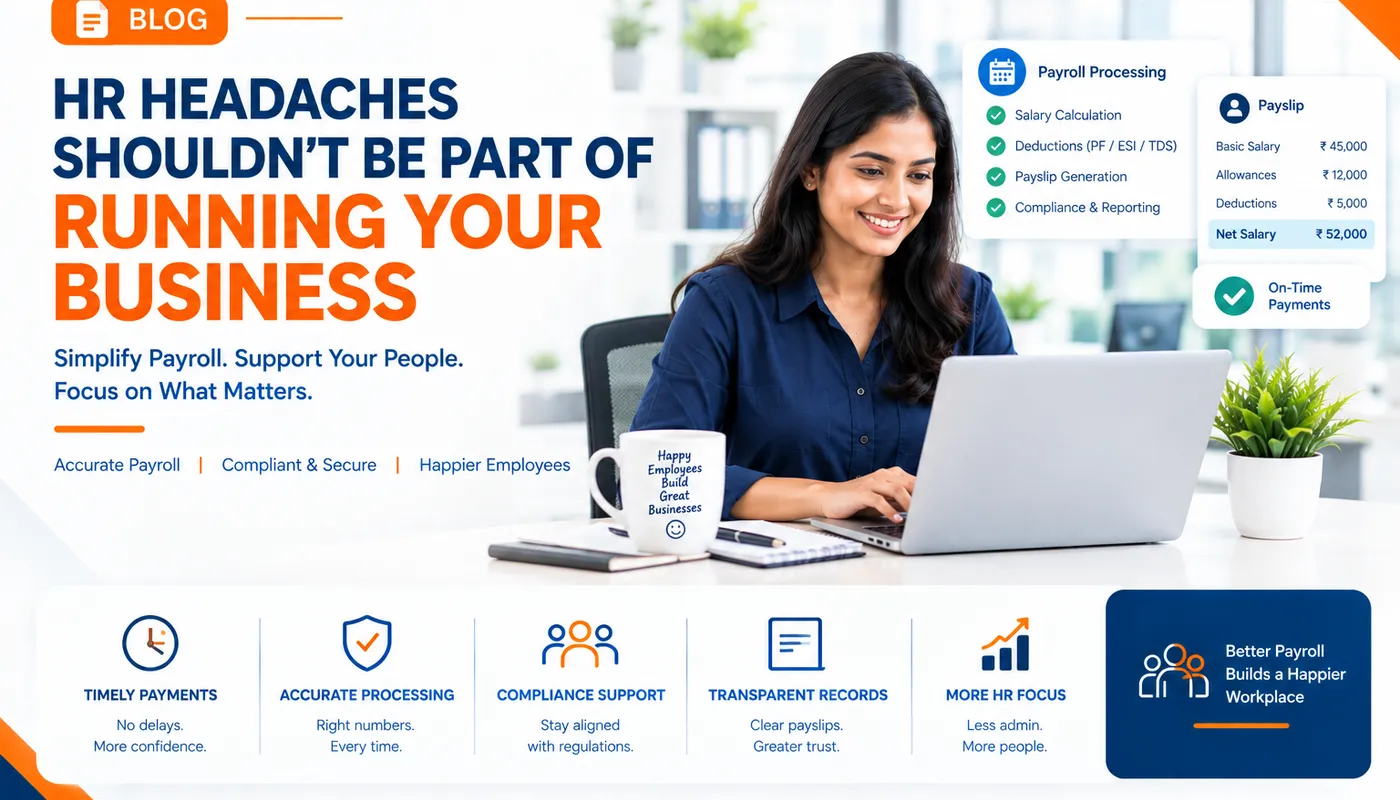
HR Headaches Shouldn't Be Part of Running Your Business
Running a growing business already involves managing customers, employees, finances, operations and long-term strategy. Payroll should not become another source of constant stress. Yet for many businesses, HR payroll management India involves spreadsheets, attendance records, salary calculations, statutory requirements, employee queries and monthly deadlines.
As employee numbers increase, even a small payroll mistake can create unnecessary work for HR and finance teams. Incorrect salary calculations, missing employee information, delayed salary slips or compliance issues can affect both internal operations and employee confidence.
This is where professional payroll support can make a meaningful difference.
Instead of spending valuable internal time on repetitive payroll administration, businesses can use structured HR payroll services India to improve payroll accuracy, simplify administration and give HR teams more time to focus on people and business priorities.
What Is HR Payroll Management?
HR payroll management is the process of managing employee salary-related activities along with the administrative and compliance requirements connected to payroll.
It can include:
- Employee data management
- Salary calculation
- Attendance and leave inputs
- Payroll processing
- Salary deductions
- PF and ESI-related administration
- TDS payroll management
- Salary slip generation
- Payroll reporting
- Employee payroll records
- Statutory payroll compliance
- Payroll queries and support
For growing companies, managing these activities manually can become increasingly difficult.
Professional payroll management services for businesses provide a structured approach to these activities, helping organisations maintain consistent payroll processes as their workforce grows.
Why Payroll Becomes an HR Headache
Payroll may appear straightforward when a company has a small team. However, the complexity increases as employee numbers, salary structures and business requirements change.
Common challenges include:
1. Managing Employee Data
HR teams need accurate employee information to process salaries correctly. Changes such as new hires, resignations, salary revisions, bank details and employee benefits need to be properly maintained.
A small data error can create additional work during payroll processing.
2. Calculating Salaries Correctly
Salary calculation can involve several components, including basic salary, allowances, deductions, attendance, leave and other applicable payroll inputs.
Manually managing these calculations increases the possibility of errors.
3. Handling Payroll Compliance
Businesses also need to manage applicable statutory payroll requirements. Depending on the organisation and employee circumstances, payroll administration may involve areas such as PF, ESI and TDS.
Keeping payroll processes organised helps businesses reduce avoidable compliance-related problems.
4. Answering Employee Payroll Questions
Employees naturally expect clarity about their salaries.
Questions regarding salary slips, deductions, leave adjustments or payroll calculations can consume considerable HR time when payroll information is not organised.
5. Managing Monthly Deadlines
Payroll is repetitive and deadline-driven. Every month, HR and finance teams need to collect inputs, verify information, process salaries and complete the required administrative activities.
When payroll is handled alongside multiple HR responsibilities, the workload can quickly become difficult to manage.
How Professional HR Payroll Management Helps
Professional payroll management is not simply about calculating salaries.
It is about creating a reliable process around employee salary management.
A structured payroll process can help businesses improve:
- Payroll accuracy
- Employee data management
- Salary processing
- Payroll reporting
- Administrative efficiency
- Compliance tracking
- Salary slip management
- HR team productivity
- Payroll transparency
For businesses considering outsourced payroll management services India, the objective should be to create a dependable payroll workflow rather than simply transfer administrative work to an external provider.
Key Services Included in Payroll Management
The exact scope can differ between providers, but professional payroll management services can cover several important areas.
Payroll Processing
Payroll processing involves collecting relevant employee inputs, calculating salaries and deductions, reviewing payroll information and preparing salary outputs.
A structured payroll processing workflow helps reduce repetitive manual work.
Employee Salary Management
Businesses need consistent processes for managing employee compensation information.
Professional employee payroll management India services can support salary calculations, employee records and payroll documentation.
Attendance and Leave Management
Attendance and leave information can directly affect payroll.
Connecting relevant attendance and leave inputs with payroll processing can reduce manual data entry and help HR teams maintain better consistency.
Salary Slips and Payroll Documentation
Employees often need salary slips for personal financial, employment or documentation purposes.
A structured payroll system can make salary slip generation and distribution easier to manage.
Payroll Reporting
Payroll reports help HR and finance teams understand salary-related information and maintain internal records.
Reports may include employee payroll summaries, salary components, deductions and other relevant payroll information.
Compliance Administration
Payroll also needs to account for applicable statutory requirements.
Payroll compliance services India can help businesses organise processes related to areas such as PF, ESI and TDS, subject to the applicable rules and employee circumstances.
When Should a Business Consider Payroll Outsourcing?
Payroll outsourcing can become relevant when internal teams are spending too much time on payroll administration or when payroll complexity is increasing.
Businesses may consider outsourcing when:
- Payroll is taking significant HR time
- Employee numbers are growing
- Payroll errors are becoming frequent
- HR teams are managing multiple responsibilities
- Compliance administration is becoming difficult
- Salary processing depends heavily on spreadsheets
- Employee payroll queries are increasing
- The company wants more structured payroll processes
- Management wants HR teams to focus on strategic activities
For startups and SMEs, outsourcing can also provide access to structured payroll administration without requiring a large dedicated internal payroll team.
Benefits of HR and Payroll Outsourcing
Working with a payroll outsourcing company India can help businesses move repetitive payroll responsibilities into a defined and professionally managed process.
Reduced Administrative Work
HR teams can spend less time on repetitive salary calculations, payroll documentation and monthly processing activities.
Better Payroll Accuracy
Standardised processes and systematic verification can help reduce avoidable payroll errors.
More Organised Employee Records
Professional payroll administration can help businesses maintain employee salary and payroll information in a structured manner.
Compliance Support
Businesses can receive support for applicable payroll compliance processes, helping internal teams manage statutory requirements more systematically.
Scalable Payroll Operations
As employee numbers increase, payroll requirements also increase.
A structured payroll service can help businesses manage changing workforce requirements without continuously increasing manual administrative work.
Better Employee Experience
Employees expect their salaries and payroll documentation to be handled accurately and consistently.
Reliable payroll administration can therefore contribute to a smoother employee experience.
How Payroll Automation Can Reduce Manual Work
Payroll automation can reduce repetitive administrative tasks by using payroll software and structured workflows.
Depending on the solution, automation may support activities such as:
- Employee data management
- Salary calculations
- Attendance inputs
- Leave information
- Payroll processing
- Salary slip generation
- Payroll reports
- Payroll records
However, automation should not mean removing human oversight completely.
Payroll teams still need to review information, verify inputs and address exceptions. The objective is to combine technology with professional payroll administration.
Why Payroll Compliance Matters in India
Payroll compliance is an important part of managing employee compensation.
Depending on the organisation and applicable employee circumstances, payroll administration may involve requirements related to:
- Provident Fund (PF)
- Employees' State Insurance (ESI)
- Tax Deducted at Source (TDS)
- Applicable statutory payroll records
- Employee documentation
Businesses should ensure that their payroll processes are aligned with the applicable laws, rules and requirements.
Professional payroll support can help HR and finance teams organise compliance-related activities and maintain appropriate payroll records.
Because statutory requirements can change, businesses should always verify current requirements through official government sources or qualified professionals.
Why SMEs Benefit from Professional Payroll Management
Small and growing businesses often have limited HR resources.
An HR manager may simultaneously handle recruitment, onboarding, employee engagement, attendance, leave management, performance processes and payroll.
Adding increasingly complex payroll administration to the same workload can reduce the time available for higher-value HR activities.
Professional HR and payroll outsourcing India services can help SMEs create a more structured payroll process while allowing internal teams to focus on business and employee priorities.
This can be particularly useful during periods of rapid hiring or organisational growth.
How PrimeSource Supports Payroll Management
PrimeSource approaches payroll management as an important part of reliable HR administration rather than treating salary processing as an isolated monthly activity.
Through professional HR payroll management India support, businesses can structure payroll-related activities around employee information, salary processing, compliance administration, reporting and ongoing payroll requirements.
The right approach depends on the company's workforce size, payroll structure, internal resources and operational requirements.
For businesses that want to reduce administrative pressure, a structured payroll partner can provide additional support while internal HR and finance teams remain focused on their core responsibilities.
What to Look for in a Payroll Management Company
Choosing a payroll provider requires more than comparing service descriptions.
Businesses should evaluate whether the provider can support their actual payroll requirements.
Consider the following:
Payroll Process
Understand how employee data, attendance, salary inputs and deductions are collected and verified.
Compliance Support
Ask how the provider handles applicable PF, ESI, TDS and other statutory payroll requirements.
Data Security
Payroll contains sensitive employee information. Businesses should understand how payroll data is handled, stored and accessed.
Technology
Check whether the provider uses appropriate payroll software and digital workflows to reduce manual work.
Reporting
Ask what payroll reports and documentation are available for HR and finance teams.
Scalability
The payroll process should be capable of supporting workforce growth and changing salary structures.
Support
Payroll issues can require timely attention. Evaluate how the provider handles employee and business queries.
Service Scope
Understand exactly which payroll activities are included and which responsibilities remain with the company.
How Much Does Payroll Management Cost in India?
The cost of professional payroll management services can vary significantly.
Pricing may depend on factors such as:
- Number of employees
- Payroll frequency
- Salary structure
- Compliance requirements
- Level of automation
- HR services included
- Reporting requirements
- Integration requirements
- Employee support requirements
Instead of selecting a provider based only on the lowest price, businesses should compare the scope of services, process quality, technology, compliance support and ongoing assistance.
The right solution should match the company's actual payroll requirements.
Common Payroll Management Mistakes Businesses Should Avoid
Some payroll problems are caused by process gaps rather than technology alone.
Common mistakes include:
- Maintaining outdated employee information
- Depending entirely on manual spreadsheets
- Not reviewing payroll inputs before processing
- Ignoring attendance and leave discrepancies
- Treating compliance as a last-minute activity
- Failing to maintain proper payroll documentation
- Not having a clear payroll approval process
- Choosing a payroll provider without checking service scope
- Giving insufficient attention to payroll data security
- Not reviewing payroll processes as the business grows
A consistent payroll workflow can help businesses address many of these issues before they become recurring problems.
Practical Tips to Make Payroll Easier
Businesses can improve payroll administration by following a few practical principles:
- Keep employee records updated.
- Establish a clear payroll calendar.
- Standardise salary inputs.
- Review attendance and leave data before processing.
- Maintain proper payroll documentation.
- Use suitable payroll software.
- Establish payroll approval checkpoints.
- Monitor applicable compliance requirements.
- Protect employee payroll information.
- Review payroll processes periodically.
- Consider outsourcing when internal payroll administration becomes difficult to manage.
The goal is not simply to process payroll every month. It is to create a process that remains accurate, organised and manageable as the business grows.
Frequently Asked Questions
1. What is HR payroll management?
HR payroll management involves managing employee salary processing along with related employee records, deductions, salary slips, reporting and applicable statutory payroll administration.
2. Why should businesses outsource payroll?
Businesses may outsource payroll to reduce administrative workload, improve process consistency, support compliance activities and allow HR teams to focus on broader employee and business responsibilities.
3. What are HR payroll services in India?
HR payroll services in India can include salary calculation, payroll processing, employee data management, salary slips, payroll reporting and support for applicable statutory requirements.
4. Is payroll outsourcing suitable for SMEs?
Yes. SMEs may consider payroll outsourcing when their internal teams have limited payroll resources or when employee numbers and payroll requirements are increasing.
5. What does payroll compliance include?
Depending on the organisation and applicable circumstances, payroll compliance can involve areas such as PF, ESI, TDS and other statutory payroll requirements.
6. Can payroll software reduce payroll errors?
Payroll software can reduce repetitive manual work and support standardised calculations and workflows. However, human review and verification remain important.
7. How do I choose a payroll management company in India?
Evaluate the provider's payroll process, compliance support, technology, data security, reporting, scalability, service scope and customer support before making a decision.
8. Can payroll management support employee satisfaction?
Accurate and timely salary processing, clear salary documentation and organised payroll support can contribute to a smoother employee experience.
Conclusion
Payroll should support your business—not become another operational headache.
As companies grow, managing salary calculations, employee records, attendance inputs, payroll reporting and compliance requirements can place increasing pressure on HR and finance teams. A structured approach to HR payroll management India can help businesses improve payroll accuracy, reduce repetitive administration and create a more reliable employee payroll experience.
For organisations considering payroll outsourcing company India solutions, the key is to choose a provider that understands their workforce, processes, compliance requirements and growth plans.
PrimeSource provides professional payroll support designed to help businesses simplify payroll administration while keeping their HR operations organised and focused on what matters most.
Take Payroll Headaches Off Your Plate with Reliable HR Payroll Management from PrimeSource
Spend less time dealing with repetitive payroll administration and more time focusing on your people and business.
Connect with PrimeSource to discuss your payroll requirements and explore a structured HR payroll management India solution suited to your organisation.