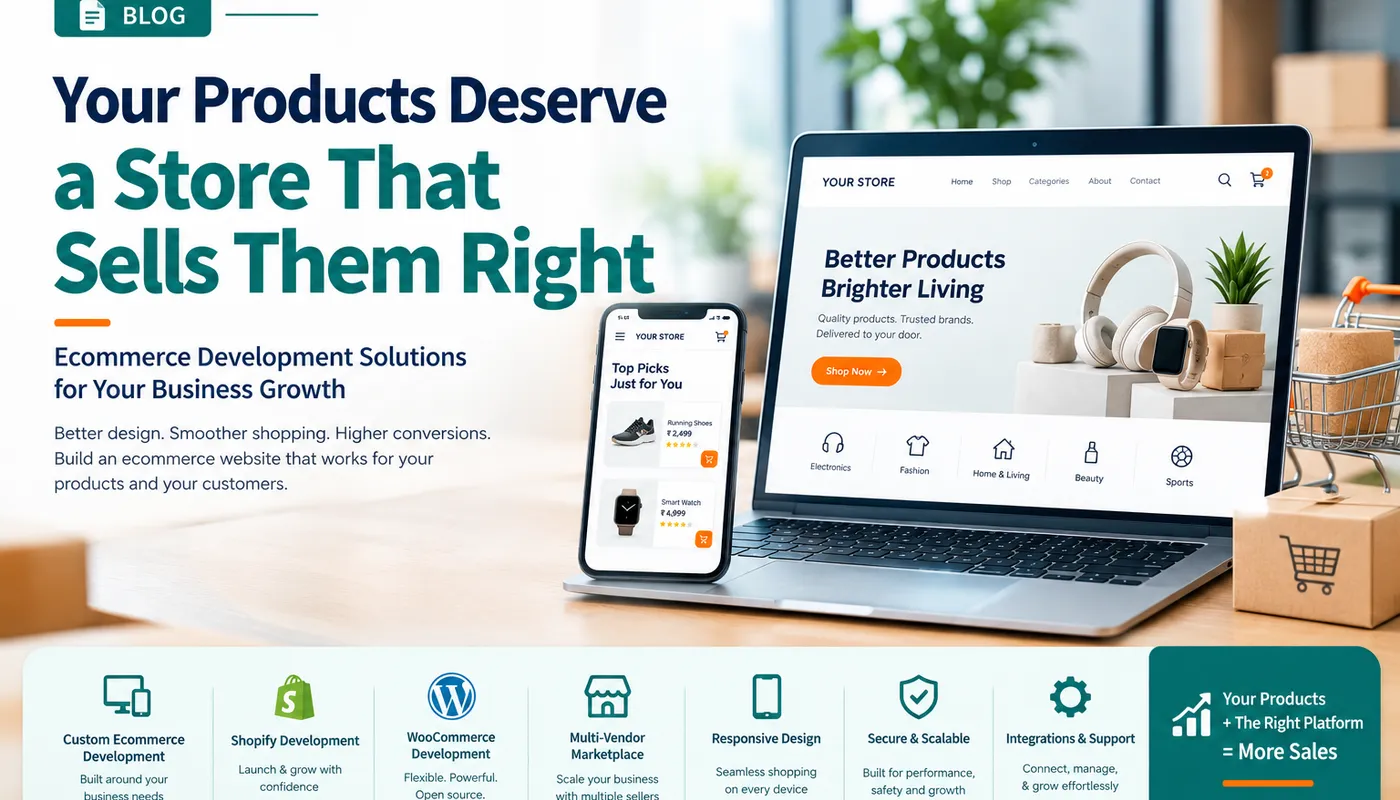
Why Your Products Deserve More Than Just an Online Store
Your products may be excellent. Your pricing may be competitive. Your brand may have a strong story.
But if your ecommerce website is difficult to navigate, slow to load, confusing at checkout, or poorly designed for mobile users, customers may never reach the purchase button.
That is why ecommerce development is not simply about putting products online.
A successful digital storefront should help customers discover products, understand their value, trust the brand, complete purchases easily, and return for future orders.
For businesses investing in ecommerce development India, the goal should be to create an online shopping experience that supports both immediate sales and long-term business growth.
Whether you are launching a new D2C brand, moving a retail business online, redesigning an existing store, or building a large marketplace, your ecommerce platform should be designed around your customers and commercial objectives.
At PrimeSource, we approach ecommerce development with that business objective in mind: build a store that works for the products, the customers, and the business behind them.
What Makes an Ecommerce Website Successful?
A successful ecommerce website combines technology, design, usability, performance, and conversion strategy.
Easy Product Discovery
Customers should be able to find what they want without unnecessary clicks.
Useful features can include:
- Product categories
- Search
- Filters
- Sorting
- Product recommendations
- Clear product information
- Related products
Good product discovery reduces friction and helps customers move naturally towards purchase.
Simple Checkout
The checkout process should be straightforward.
Customers should be able to review their cart, enter delivery details, select payment options, and complete the purchase without unnecessary complexity.
Mobile-Friendly Shopping
A large portion of online shopping activity happens through smartphones. Mobile responsive ecommerce should therefore be a fundamental part of development rather than an afterthought.
Fast Performance
Slow pages can negatively affect the shopping experience.
Optimised images, efficient code, appropriate hosting, caching, and careful use of third-party scripts can help improve ecommerce website performance.
Trust and Security
Customers need confidence before providing personal and payment information.
An ecommerce store should therefore consider secure connections, appropriate authentication, payment security, access controls, software updates, backups, and other relevant security measures.
Conversion-Focused Design
A professional store should make it obvious what customers can do next.
Clear product information, calls-to-action, trust signals, reviews, delivery information, and simple navigation can all contribute to a better purchasing journey.
Our Ecommerce Development Solutions for Growing Businesses
Different businesses need different ecommerce platforms and development approaches.
PrimeSource can support businesses with ecommerce solutions based on their products, customers, operational requirements, and growth plans.
Custom Ecommerce Development
A custom ecommerce website development company India can build functionality specifically around your business model.
Custom ecommerce development can be useful when standard platform functionality does not adequately support your requirements.
Possible capabilities include:
- Custom product workflows
- Special pricing logic
- Custom customer journeys
- Business-specific dashboards
- Third-party integrations
- Advanced catalogue structures
- Custom checkout experiences
Shopify Development
Shopify provides a managed ecommerce platform that can be suitable for many brands that want to launch and manage an online store efficiently.
Shopify store development can include theme customisation, store configuration, app integrations, product setup, checkout configuration, and custom functionality.
Businesses looking for a Shopify developer India should consider both design capabilities and technical understanding when selecting a development partner.
WooCommerce Development
WooCommerce extends WordPress with ecommerce functionality.
It can be suitable for businesses that want a flexible online store combined with content management capabilities.
Shopify WooCommerce store development services India can help businesses select and customise the platform according to their operational requirements.
Multi-Vendor Marketplace Development
A marketplace is different from a standard ecommerce store because multiple sellers may operate through the same platform.
Multi-vendor marketplace development India affordable solutions may include:
- Seller registration
- Seller dashboards
- Product management
- Commission management
- Order management
- Customer accounts
- Seller payouts
- Reviews and ratings
Headless Ecommerce Development
Headless commerce separates the customer-facing frontend from the ecommerce backend.
This approach can provide greater flexibility for businesses with advanced experience requirements, multiple customer channels, or complex digital ecosystems.
Headless ecommerce development India can be considered when businesses require greater control over frontend experiences and integrations.
D2C Ecommerce Development
D2C brands often need ecommerce experiences that strongly communicate brand identity while supporting marketing, customer acquisition, retention, and sales.
A D2C brand ecommerce website development India solution can combine product storytelling, conversion-focused design, customer accounts, analytics, marketing integrations, and ecommerce functionality.
Shopify vs WooCommerce vs Custom Ecommerce Development
There is no universally correct ecommerce platform.
The best choice depends on your business requirements.
Requirement
Shopify
WooCommerce
Custom Ecommerce
Ease of management
High
Moderate
Depends on development
Customisation
High
High
Very high
Content management
Good
Excellent
Custom
Ecommerce functionality
Strong
Strong
Fully customisable
Technical control
Moderate
High
Very high
Best suited for
Growing online stores
Content-driven stores
Complex requirements
Scalability
Strong
Strong with proper setup
Designed around requirements
A business launching its first online store may prefer a platform that is quick to manage.
A content-heavy brand may prefer WooCommerce.
A company with complex workflows, unique integrations, or highly specialised requirements may benefit from custom development.
The right ecommerce platform should be selected based on business needs rather than trends alone.
How We Build Ecommerce Stores That Support Sales and Growth
Professional ecommerce development should follow a structured process.
1. Business and Requirement Discovery
The first step is understanding the products, target customers, sales model, competitors, business goals, and operational requirements.
2. Platform Selection
The development approach is selected based on functionality, budget, scalability, integrations, content requirements, and long-term plans.
3. Ecommerce UI/UX Design
The design should make product discovery and purchasing easy.
This includes navigation, category pages, product pages, cart experience, checkout, account areas, and responsive layouts.
4. Development
Frontend and backend functionality are developed according to the approved requirements.
5. Integrations
Depending on the business, integrations may include:
- Payment gateways
- CRM systems
- ERP platforms
- Shipping providers
- Inventory systems
- Marketing tools
- Analytics
- Tax systems
6. Testing
The store should be tested across devices and browsers.
Important areas include product functionality, cart operations, checkout, payment processing, forms, account management, integrations, and performance.
7. Launch and Optimisation
After deployment, businesses can monitor customer behaviour, sales performance, conversion rates, and technical performance to identify further improvements.
Essential Features Every Professional Ecommerce Store Needs
The exact feature set depends on the business, but most professional stores require a strong foundation.
Product Catalogue
Customers need clear product names, descriptions, specifications, images, prices, variations, availability, and relevant information.
Shopping Cart
The cart should allow customers to review products, adjust quantities, remove items, and understand their order total.
Checkout
A streamlined checkout should reduce unnecessary friction.
Payment Gateway Integration
Online payment integration can support multiple payment methods depending on the target market and business requirements.
Order Management
Businesses need a reliable way to view, process, update, and track orders.
Inventory Management
Inventory functionality helps businesses manage stock availability and reduce problems associated with overselling.
Customer Accounts
Customer account functionality can provide access to order history, addresses, profile information, and other relevant features.
Analytics
Ecommerce analytics can help businesses understand traffic, product performance, conversion rates, sales, and customer behaviour.
SEO-Friendly Structure
Ecommerce websites should also be developed with search visibility in mind through appropriate page structure, URLs, metadata, internal linking, performance, and indexability.
How Ecommerce Website Design and UX Influence Conversions
A customer should not have to work hard to purchase a product.
Effective ecommerce website design considers every stage of the customer journey.
A typical journey looks like:
Search → Product Discovery → Product Page → Cart → Checkout → Payment → Confirmation
Problems at any stage can cause customers to leave.
For example, a product page may lose potential buyers if:
- Images are poor quality
- Product information is incomplete
- Price is difficult to find
- Delivery information is unclear
- The CTA is difficult to identify
- Reviews are missing
- The page loads slowly
A conversion-focused ecommerce website therefore combines visual design with practical usability.
The objective is not to make every element impressive.
The objective is to make the buying journey clear, trustworthy, and convenient.
Ecommerce Development for D2C Brands, Startups and Enterprises
Startups
Startups often need to validate products and build an online sales channel without unnecessary technical complexity.
An ecommerce solution should provide essential functionality while leaving room for future growth.
D2C Brands
D2C brands need strong branding, product storytelling, customer experience, marketing integrations, and ecommerce functionality.
Retail Businesses Moving Online
Businesses moving from offline to online may need to connect their existing product, inventory, payment, delivery, and customer processes with their new digital storefront.
SMEs
SMEs often need practical ecommerce solutions that balance functionality, cost, manageability, and scalability.
Enterprises
Enterprise ecommerce projects can involve multiple systems, large product catalogues, complex workflows, advanced integrations, multiple locations, and high traffic requirements.
The development approach should therefore match the scale and operational complexity of the business.
How Much Does Ecommerce Development Cost in India?
There is no universal ecommerce development cost India quote.
Pricing depends on the scope of the project and the technology selected.
Important factors include:
- Number of products
- Design requirements
- Platform
- Custom functionality
- Payment gateways
- Shipping integrations
- Inventory management
- CRM or ERP integrations
- Marketplace functionality
- Customer accounts
- Automation
- SEO requirements
- Security
- Performance requirements
- Maintenance and support
A simple online store and a custom ecommerce platform can have dramatically different development requirements.
When reviewing ecommerce website pricing, businesses should ask what is included in the quotation.
A proper ecommerce development quotation should clarify:
Platform + Design + Development + Features + Integrations + Testing + Deployment + Support
This makes it easier to compare proposals based on actual business value rather than simply choosing the lowest price.
When Should You Choose Custom or Headless Ecommerce Development?
Custom or headless development may make sense when standard ecommerce platforms cannot efficiently handle your requirements.
Consider these approaches when you need:
- Highly customised customer experiences
- Complex product structures
- Advanced integrations
- Unique business workflows
- Multiple digital channels
- Custom checkout logic
- High levels of frontend control
- Complex enterprise requirements
However, custom development is not automatically better.
If a standard platform can fulfil your requirements effectively, using that platform may reduce complexity and development overhead.
The best approach is the one that provides the right balance of functionality, performance, scalability, maintainability, and investment.
How to Choose the Right Ecommerce Development Company in India
Choosing an ecommerce development company India requires careful evaluation.
Review Relevant Experience
Look at ecommerce projects similar to your business model.
Check Platform Expertise
If you want Shopify, WooCommerce, custom ecommerce, or headless commerce, ensure the development team has relevant technical experience.
Evaluate UX Capability
Technical functionality alone is not enough. The team should understand ecommerce UI/UX and customer journeys.
Ask About Integrations
If your business depends on CRM, ERP, shipping, inventory, payment, or marketing systems, discuss those requirements before development begins.
Understand Scalability
Your ecommerce platform should be capable of supporting future product growth, traffic, customers, and functionality.
Ask About Support
Find out how the provider handles maintenance, updates, technical issues, security, and future improvements.
Request a Detailed Proposal
Before choosing a provider, request a clear ecommerce development quotation covering scope, platform, features, timeline, commercial terms, and support.
Why Choose PrimeSource for Ecommerce Development?
PrimeSource focuses on ecommerce development from both the technology and business perspective.
The objective is not simply to build an online store. It is to create a digital storefront that supports product discovery, customer experience, sales, operational efficiency, and future growth.
Depending on your requirements, PrimeSource can support:
- Custom ecommerce development
- Shopify development
- WooCommerce development
- D2C ecommerce websites
- Multi-vendor marketplaces
- Responsive ecommerce design
- Payment gateway integration
- CRM and ERP integrations
- Shipping and inventory integrations
- Ecommerce SEO foundations
- Website performance optimisation
- Ecommerce maintenance and support
For businesses looking to build my ecommerce store India professional, the right development process begins by understanding what the business needs the store to accomplish.
Whether you are a startup launching your first product, a D2C brand expanding online, a retailer moving from offline to online, or an enterprise upgrading its ecommerce infrastructure, PrimeSource can help you evaluate the appropriate development approach.
Frequently Asked Questions
1. What is ecommerce development?
Ecommerce development is the process of designing and building an online store or ecommerce platform, including product catalogues, shopping carts, checkout, payments, customer accounts, order management, integrations, and other required functionality.
2. Which ecommerce platform is best for a business?
There is no single best platform. Shopify, WooCommerce, custom ecommerce, and headless commerce can each be suitable for different business requirements.
3. Is Shopify suitable for D2C brands?
Yes. Shopify can be suitable for D2C businesses that need a manageable ecommerce platform with strong store functionality and opportunities for customisation and integrations.
4. Is WooCommerce good for small businesses?
WooCommerce can be suitable for small and growing businesses, particularly those that want WordPress-based content management combined with ecommerce functionality.
5. How much does ecommerce development cost in India?
The cost depends on the platform, number of products, design, functionality, integrations, customisation, security, performance, and support requirements.
6. Can you develop a multi-vendor marketplace?
Yes. A multi-vendor marketplace can be developed with seller registration, product management, commissions, orders, payouts, customer accounts, and other required functionality.
7. What is headless ecommerce?
Headless ecommerce separates the frontend customer experience from the ecommerce backend, giving businesses greater flexibility over how the storefront is presented and integrated with other digital channels.
8. Can ecommerce websites be integrated with ERP and CRM systems?
Yes. Depending on the systems involved, ecommerce stores can be integrated with CRM, ERP, inventory, shipping, payment, analytics, marketing, and other third-party platforms.
9. Should an ecommerce website be mobile responsive?
Yes. Mobile responsive design is essential because customers may browse products and complete purchases using smartphones and tablets.
10. How can I hire ecommerce developers in India?
Define your ecommerce model, platform preference, features, integrations, budget, and timeline first. Then evaluate ecommerce developers based on relevant experience, technical capability, portfolio, communication, scalability, and post-launch support.
Your Products Deserve a Store That Sells Them Right
Your ecommerce website is where your products meet your customers.
That experience should make it easy to discover products, understand their value, trust your brand, complete purchases, and return for more.
Whether you need a Shopify store, WooCommerce website, custom ecommerce platform, D2C storefront, multi-vendor marketplace, or headless ecommerce solution, the development approach should be based on your business—not simply on what technology is currently popular.
PrimeSource helps businesses explore practical ecommerce development services India with a focus on professional design, responsive experiences, ecommerce functionality, integrations, performance, scalability, and long-term growth.
If you are ready to build a professional ecommerce website, redesign your existing store, move your retail business online, or discuss a dedicated development team, now is the right time to start with your requirements.
Your products deserve a store that sells them right.
Talk to PrimeSource about your ecommerce project, request an ecommerce development cost India quote, and take the next step toward building a stronger digital storefront for your business.